
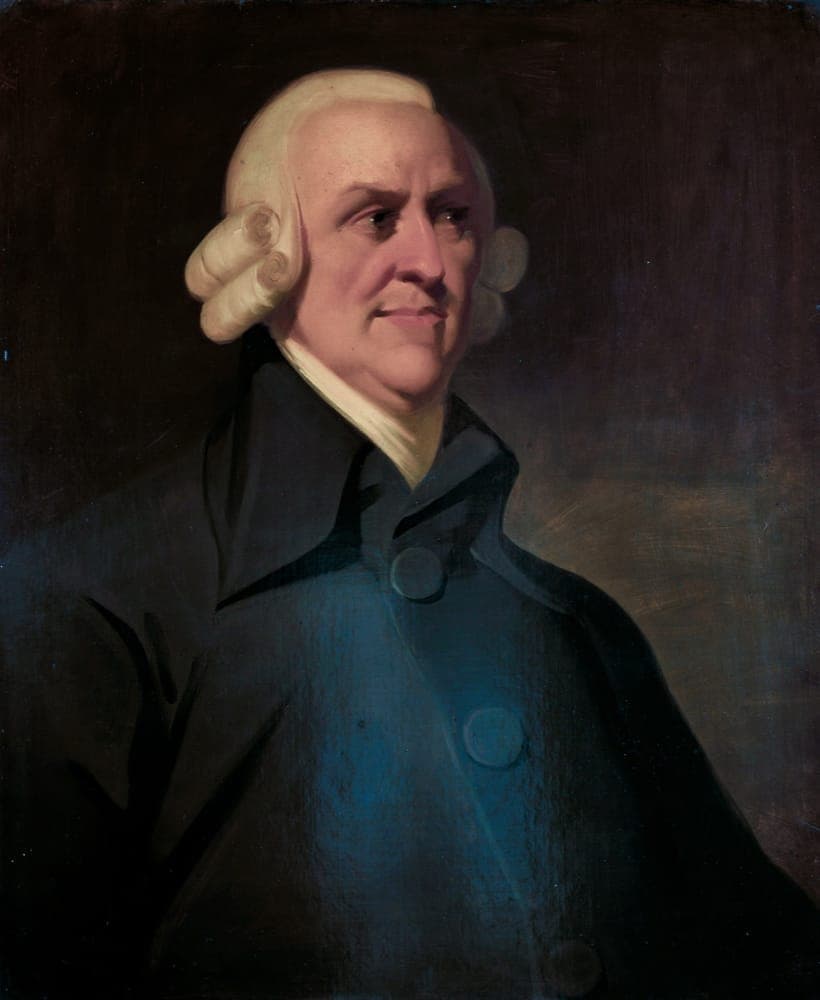
Author
Adam Smith
- Lived
- Lived 1723 to 1790
- From
- From Scottish
Baptised on June 16, 1723, in the small fishing burgh of Kirkcaldy, Fife, Adam Smith was the posthumous son of a customs official who had died two months earlier, and he was raised by his widowed mother, Margaret Douglas, to whom he remained devoted for life. At fourteen he entered the University of Glasgow, where he studied under Francis Hutcheson, then won a scholarship to Balliol College, Oxford, where he found the dons indifferent and read widely on his own. Returning to Scotland, he began public lectures in Edinburgh and in 1751 became professor of logic, then of moral philosophy, at Glasgow, calling those years the happiest of his life. His first book, The Theory of Moral Sentiments (1759), grounded ethics in human sympathy and made his name across Europe. In 1764 he left the chair to tutor the young Duke of Buccleuch on a continental tour, meeting Voltaire, Quesnay, and the French economists in Paris. Back in Kirkcaldy he spent roughly a decade writing An Inquiry into the Nature and Causes of the Wealth of Nations (1776), which examined the division of labour, the workings of the market, and the proposition that self-interest, guided as if by an invisible hand, could serve the common good. A shy, absent-minded bachelor, he once fell into a tanning pit while talking, and reputedly walked fifteen miles in his dressing gown lost in thought. He was appointed Commissioner of Customs in 1778, an office once held by his father, and never married. Shortly before the end he had most of his unpublished papers, sixteen volumes of manuscript, burned in his presence, and he died on July 17, 1790, in his house on the Canongate in Edinburgh, at the age of sixty-seven.
The first button needs the app on this device; the second gets it there.
In the canon
- The Theory Of Moral Sentiments1759
- The Wealth of Nations1776