
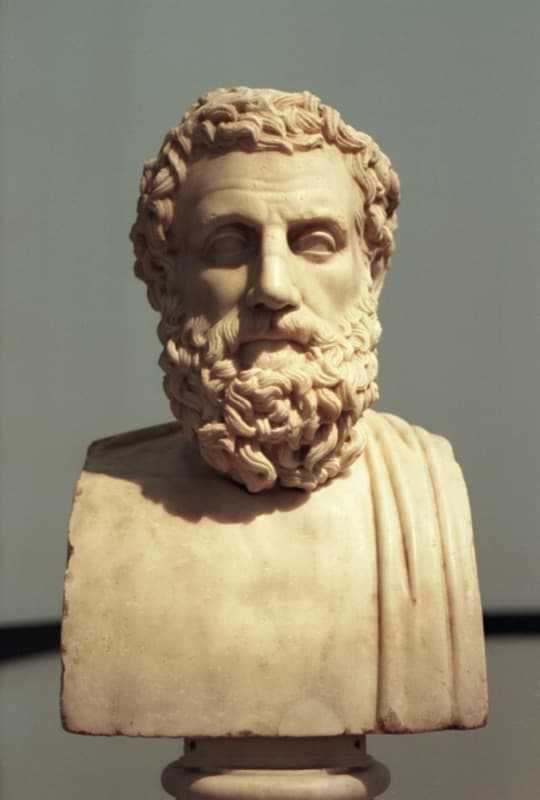
Author
Aeschylus
- Lived
- Lived 525 BCE to 456 BCE
- From
- From Ancient Greek
- Born in
- Born in Eleusis, Greece
Born around 525 BCE in Eleusis, a sacred town fifteen miles northwest of Athens, Aeschylus grew up in the rituals of the Eleusinian Mysteries, whose secrecy he was later accused of violating on stage. He fought at Marathon in 490 BCE, a fact he valued so highly that his self-composed epitaph mentioned only his military service and not a single play. He transformed the Dionysia by introducing a second actor, making genuine dialogue and dramatic conflict possible for the first time. The Persians (472 BCE), the oldest surviving play in Western theater, staged the Battle of Salamis from the perspective of the defeated enemy, an act of radical empathy performed before an audience of veterans. The Oresteia (458 BCE), Agamemnon, The Libation Bearers, The Eumenides, remains the only complete Greek tragic trilogy to survive, tracing the passage from blood vengeance to civic justice through some of the most ferocious poetry ever written for the stage. Of perhaps ninety plays, only seven survive. He won first prize at the Dionysia thirteen times during his lifetime and continued to win posthumously, Athens granting the unprecedented honor of restaging his work after his death. He died in 456 BCE at Gela in Sicily, where legend, almost certainly apocryphal, holds that an eagle dropped a tortoise on his bald head, mistaking it for a stone.
Accused before the Areopagus of revealing the secret rites of Eleusis on stage, Aeschylus fled a mob to the altar of Dionysus in the theater itself. At trial he pleaded he had never been initiated and could not have betrayed what he did not know. The jury, moved by his own war record, acquitted him.
The first button needs the app on this device; the second gets it there.
In the canon
- The Persians471 BCE
- Seven Against Thebes467 BCE
- The Suppliants463 BCE
- Oresteia458 BCE
- Prometheus Bound455 BCE