
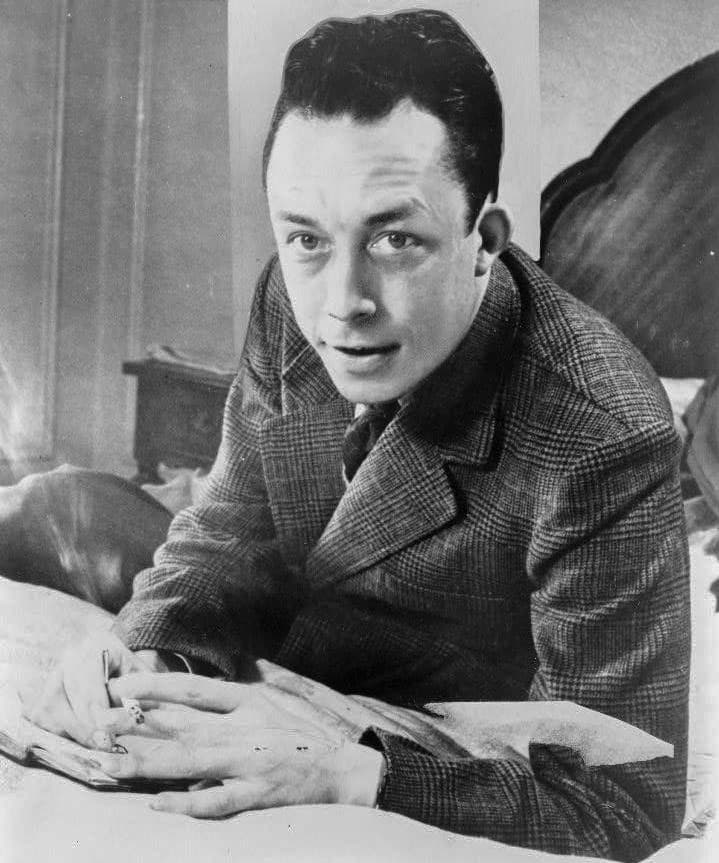
Author
Albert Camus
- Lived
- Lived 1913 to 1960
- From
- From French-Algerian
- Born in
- Born in Mondovi, French Algeria
Born in 1913 in Mondovi, French Algeria, Camus never knew his father, who was killed at the Battle of the Marne in 1914. He grew up in a two-room apartment in Algiers with his nearly deaf, illiterate mother and a domineering grandmother, and was rescued from poverty by a schoolteacher who recognized his gifts and pushed him toward a scholarship. Tuberculosis at seventeen ended his hopes of an academic career and gave him the intimate acquaintance with death that runs through all his work. He became a journalist, joined the French Resistance during the occupation, and edited the underground newspaper Combat. The Stranger (1942) and The Myth of Sisyphus (1942) articulated the philosophy of the absurd with Mediterranean clarity. The Plague (1947) made him internationally famous. He won the Nobel Prize in 1957 at forty-four, the second-youngest laureate. His public break with Sartre over the question of political violence defined the intellectual battle lines of the Cold War. He died on January 4, 1960, when the car driven by his publisher Michel Gallimard struck a tree on a straight road in Burgundy. An unused train ticket was found in his coat pocket.
Accepting the Nobel Prize in 1957, Camus was challenged by an Algerian student who accused him of staying silent while war tore his homeland apart. Bombs were being planted in the trams of Algiers, where his mother still lived. He believed in justice, he said, but would defend his mother before it.
The first button needs the app on this device; the second gets it there.
In the canon
- Caligula1938
- The Stranger1942
- The Myth of Sisyphus1942
- The Misunderstanding1944
- The Plague1947
- The Rebel1951
- Return to Tipasa1954
- The Fall1956
- The First Man1994