
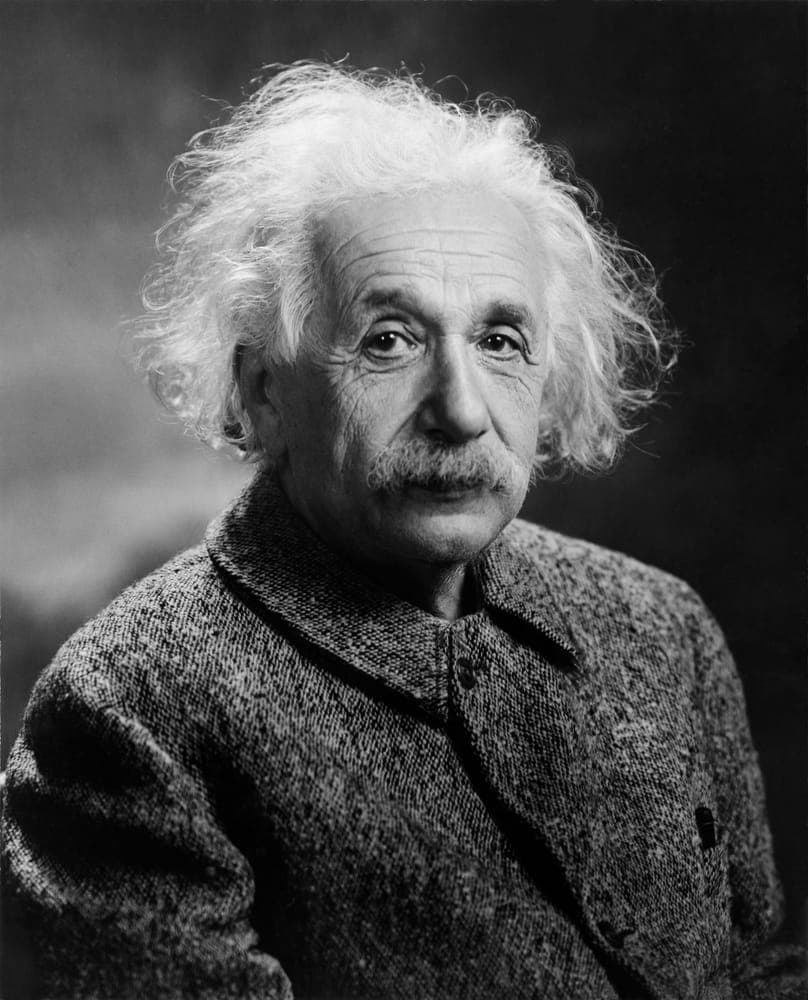
Author
Albert Einstein
- Lived
- Lived 1879 to 1955
- From
- From German-American
- Born in
- Born in Ulm, Württemberg
Born Albert Einstein on March 14, 1879, in Ulm, Württemberg, the only son of secular Ashkenazi Jewish parents whose electrical equipment firm later moved them to Munich, he was slow to speak as a small child and quick to bristle against authority as an older one. He renounced his German citizenship at sixteen, completed his schooling in Aarau, and graduated from the Zurich Polytechnic in 1900. Unable to find an academic post, he took a job as a third-class examiner at the Swiss Patent Office in Bern in 1902. There, in 1905, his annus mirabilis, he published four papers that recast modern physics: on the photoelectric effect, Brownian motion, special relativity, and the equivalence of mass and energy. General relativity, completed in November 1915, predicted the bending of starlight around the sun and was confirmed by Arthur Eddington's eclipse expedition to Príncipe in 1919, making Einstein a global celebrity overnight. He received the 1921 Nobel Prize in Physics for the photoelectric work. The popular exposition Relativity: The Special and the General Theory (1916) introduced his ideas to the general reader. He left Germany permanently in 1933 when Hitler came to power, settled at the Institute for Advanced Study in Princeton, and in August 1939 signed the letter to President Roosevelt that initiated the Manhattan Project, a decision he afterwards described as the greatest mistake of his life. He spent his last decades in fruitless pursuit of a unified field theory. He died on April 18, 1955, in Princeton, at the age of seventy-six, having refused surgery for an aortic aneurysm, saying he wished to go elegantly.
In September 1919, physicist Ilse Rosenthal-Schneider was with Einstein when a telegram confirmed that Arthur Eddington's eclipse expedition had measured starlight bending exactly as general relativity predicted. She asked what he would have said had the result gone against him. "Then I would have been sorry for the dear Lord," he replied. "The theory is correct."
The first button needs the app on this device; the second gets it there.
In the canon
- Relativity1916
- The World As I See It1930