
Author
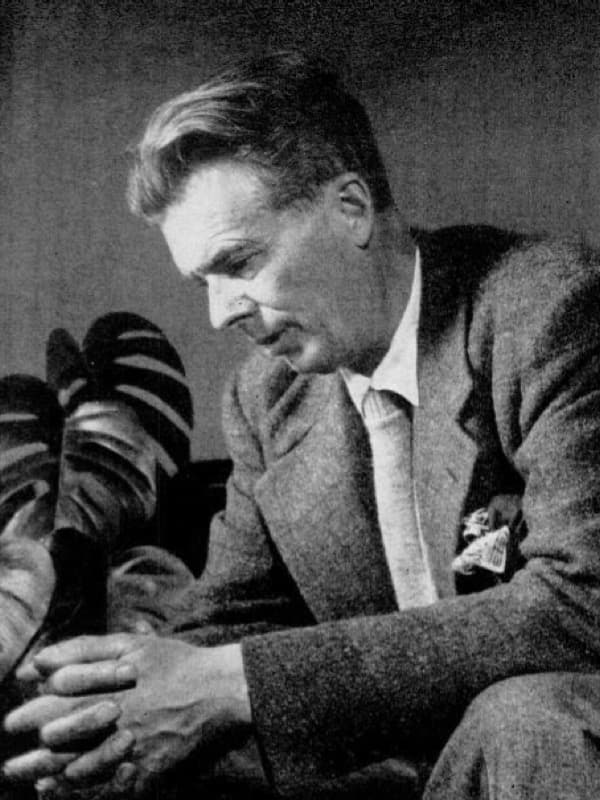
Aldous Huxley
- Lived
- Lived 1894 to 1963
- From
- From English
- Born in
- Born in Godalming, Surrey
Born on July 26, 1894, in Godalming, Surrey, into one of England's most formidable intellectual dynasties, his grandfather was Thomas Henry Huxley, Darwin's fiercest champion, and his brother Julian would become the first director of UNESCO, Huxley seemed destined for science until keratitis nearly blinded him at sixteen. He learned Braille, recovered partial sight, and turned to literature. His early novels Crome Yellow (1921) and Point Counter Point (1928) established him as a caustic satirist of the English upper classes. Brave New World (1932), written in four months, imagined a dystopia engineered not through punishment but through pleasure, soma, hypnopaedia, and the elimination of solitude, and it has only grown more unsettling with time. He moved to Los Angeles in 1937 and grew increasingly absorbed by mysticism and perception. The Doors of Perception (1954) documented his mescaline experiments with a clinical eye and gave a rock band its name. His late novel Island (1962) attempted a utopian counterpoint to Brave New World, the vision of a good society he had spent decades refining. Huxley died on November 22, 1963, the same day as John F. Kennedy and C. S. Lewis, his death all but unnoticed amid the assassination. On his deathbed, unable to speak, he wrote a note to his wife: "LSD, 100 micrograms, intramuscular."
In September 1917, half-blind and twenty-three, Huxley took a post teaching French at Eton. By his own students' account he was a hopeless disciplinarian with almost no authority over his class. One of the boys he taught was Eric Blair, later known to the world as George Orwell.
LSD, 100 micrograms, intramuscular.
The first button needs the app on this device; the second gets it there.
In the canon
- Crome Yellow1921
- Antic Hay1923
- Point Counter Point1928
- Brave New World1932
- Eyeless in Gaza1936
- After Many a Summer1939
- The Perennial Philosophy1945
- The Doors Of Perception1954
- Island1962