
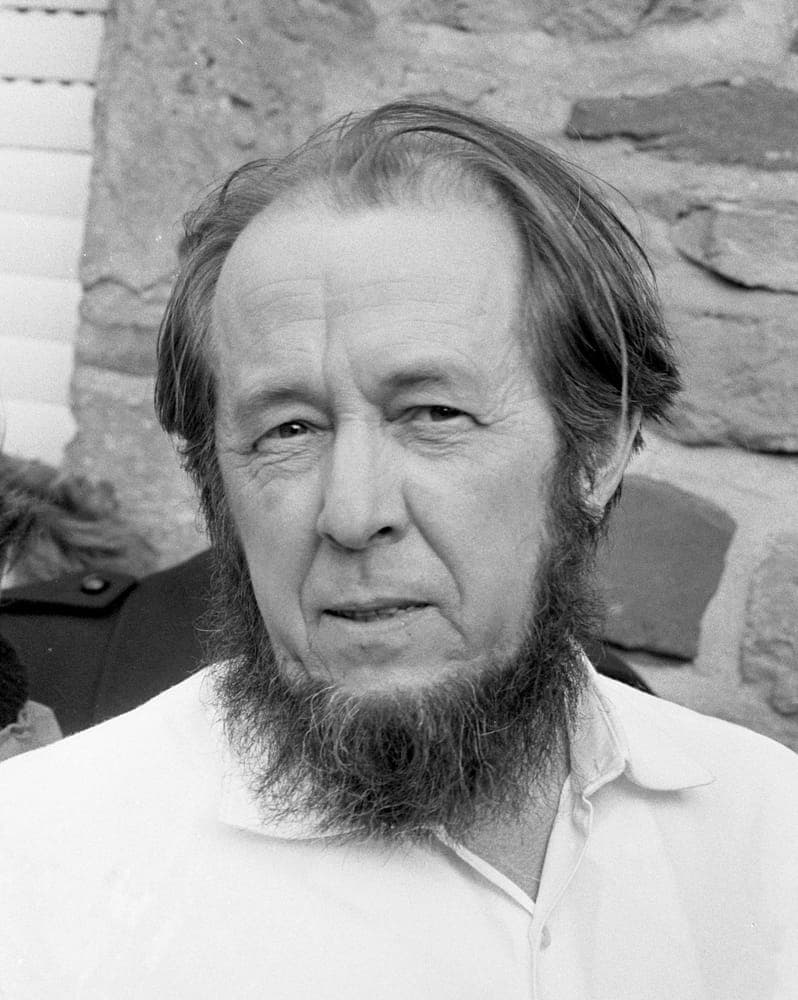
Author
Aleksandr Solzhenitsyn
- Lived
- Lived 1918 to 2008
- From
- From Russian
- Born in
- Born in Kislovodsk, Russia
Born Aleksandr Isayevich Solzhenitsyn on December 11, 1918, in Kislovodsk, in the Caucasus foothills of southern Russia, six months after his father, a young Imperial Army officer of Cossack origin, was killed in a hunting accident, he was raised in poverty by his widowed mother Taisiya and his aunt. His maternal grandfather had been a Kuban landowner, dispossessed by the Bolsheviks. He took a degree in mathematics and physics at Rostov State University in 1941 and was conscripted into the Red Army that summer. He served as a captain of an artillery sound-ranging battery from Kursk to East Prussia, and in February 1945 was arrested at the front by SMERSH for private letters criticizing Stalin. He was sentenced to eight years in the Gulag and three more in internal exile in Kazakhstan, where he survived treatment for cancer at Tashkent. One Day in the Life of Ivan Denisovich (1962), the bare account of a single shift in a Siberian camp, was published in Novy Mir with Khrushchev's personal approval and made him famous overnight. The thaw soon closed. Cancer Ward (1967) and In the First Circle (1968) appeared abroad in samizdat translations, and in 1970 he was awarded the Nobel Prize in Literature for "the ethical force with which he has pursued the indispensable traditions of Russian literature." When The Gulag Archipelago (1973) was published in Paris, the Soviet state stripped him of his citizenship and put him on a plane to West Germany. He settled at Cavendish, Vermont, for eighteen years, writing the Red Wheel cycle in seclusion. His citizenship was restored in 1990. He returned to Russia in 1994 and died at his home outside Moscow on August 3, 2008, at eighty-nine.
In the Kuibyshev transit prison, Solzhenitsyn watched Catholic prisoners knot rosaries and asked for one of his own, a hundred beads with every tenth cast larger. He used it to count lines of verse he dared not write down, reciting and re-reciting until he had memorized twelve thousand lines by his release.
The first button needs the app on this device; the second gets it there.
In the canon
- One Day in the Life of Ivan Denisovich1962
- Cancer Ward1967
- First Circle1968
- August 19141971
- The Gulag Archipelago1973
- The Gulag Archipelago [Volume 1]: An Experiment in Literary Investigation1973