
Author
Alexander Pushkin
- Lived
- Lived 1799 to 1837
- From
- From Russian
- Born in
- Born in Moscow, Russia
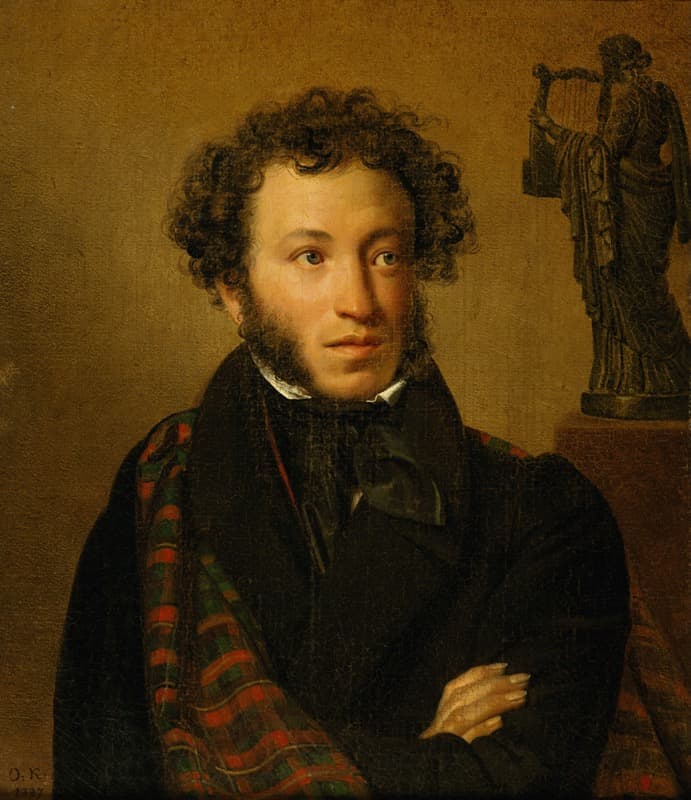
Born in 1799 in Moscow into the Russian nobility, Pushkin inherited African ancestry through his maternal great-grandfather Abram Gannibal, an Abyssinian prince who became a general under Peter the Great. At the Imperial Lyceum at Tsarskoye Selo he was already writing verses that astonished his teachers, and by twenty he had published Ruslan and Ludmila (1820), a narrative poem that scandalized classicists and delighted everyone else. His radical sympathies earned him six years of internal exile, during which enforced solitude proved extraordinarily productive. Eugene Onegin (1825-1832), a novel in verse, invented Russian literary realism in fourteen-line stanzas of breathtaking fluency. Boris Godunov (1825) broke with neoclassical dramatic conventions to create a Shakespearean historical tragedy. The Bronze Horseman (1833) and The Queen of Spades (1834) showed his mastery of compressed narrative and the uncanny. He married the beautiful Natalya Goncharova in 1831, but her admirers tormented him. When the French officer Georges d'Anthes persisted in publicly courting his wife, Pushkin challenged him to a duel on the banks of the Black River outside St. Petersburg on January 27, 1837. D'Anthes fired first. Pushkin, shot through the abdomen, died two days later at thirty-seven, and all of Russia understood that its literature had lost its founding voice.
At a Lyceum examination in January 1815, the fifteen-year-old Pushkin recited his 'Recollections in Tsarskoe Selo' before Derzhavin, the greatest living Russian poet. Derzhavin, ecstatic, demanded to embrace the boy. They searched the hall and could not find him. 'I don't remember how I finished my reading,' Pushkin recalled; 'I don't remember how I ran away.'
The first button needs the app on this device; the second gets it there.
In the canon
- The Gypsies1827
- Mozart and Salieri1830
- Boris Godunov1831
- The Stationmaster1831
- The Little Tragedies1832
- Eugene Onegin1833
- The Queen Of Spades1834
- The Captain's Daughter1836
- The Bronze Horseman1837