
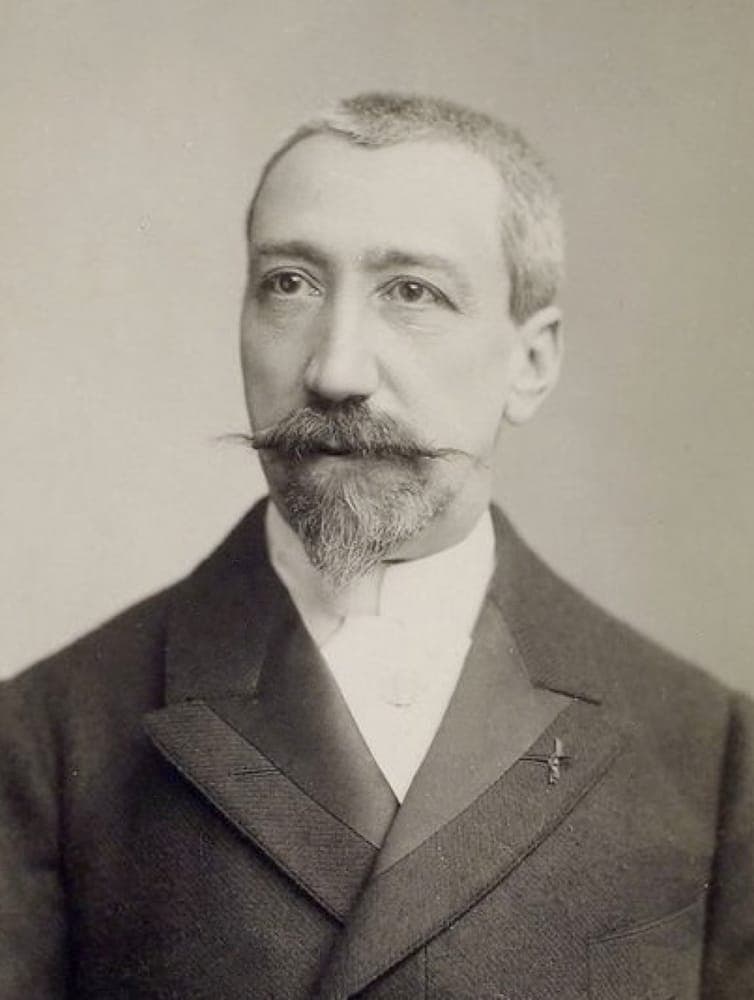
Author
Anatole France
- Lived
- Lived 1844 to 1924
- From
- From French
Born Jacques Anatole François Thibault on April 16, 1844, in Paris, he was the son of a bookseller whose quayside shop on the Quai Malaquais specialized in volumes about the French Revolution. The boy grew up among those stacks, breathing the dust of old paper, and took his pen name from his father, who was known to customers as Monsieur France. He failed his baccalaureate twice before finding work as a publisher's reader and cataloguer, then as a journalist and reviewer for Le Temps. His early novel The Crime of Sylvestre Bonnard (1881) won a prize from the Academie Francaise and made his name. Thais (1890) followed, the story of a fourth-century monk whose attempt to save a courtesan from sin destroys his own faith instead, later set to music by Massenet. He wrote with irony and a polished classical clarity in The Red Lily (1894), the four-volume Contemporary History (1897-1901), and Penguin Island (1908), a satire of French history told as the chronicle of baptized birds. The Dreyfus Affair turned him toward open politics; he returned the Legion of Honour ribbon in protest and grew increasingly socialist. The Gods Are Athirst (1912) gave the Terror a human face. He won the Nobel Prize in Literature in 1921, cited for a style of nobility and Gallic temperament. Three years later, in 1924, the Catholic Church placed his entire body of work on the Index of Forbidden Books. He died on October 12, 1924, at his home La Bechellerie near Tours, at the age of eighty, and was given a state funeral.
The first button needs the app on this device; the second gets it there.
In the canon
- Thaïs1890
- The Well Of St. Clare1895
- Penguin Island1908
- The Gods Will Have Blood1912
- The Revolt Of The Angels1914