
Author
André Malraux
- Lived
- Lived 1901 to 1976
- From
- From French
- Born in
- Born in Paris, France
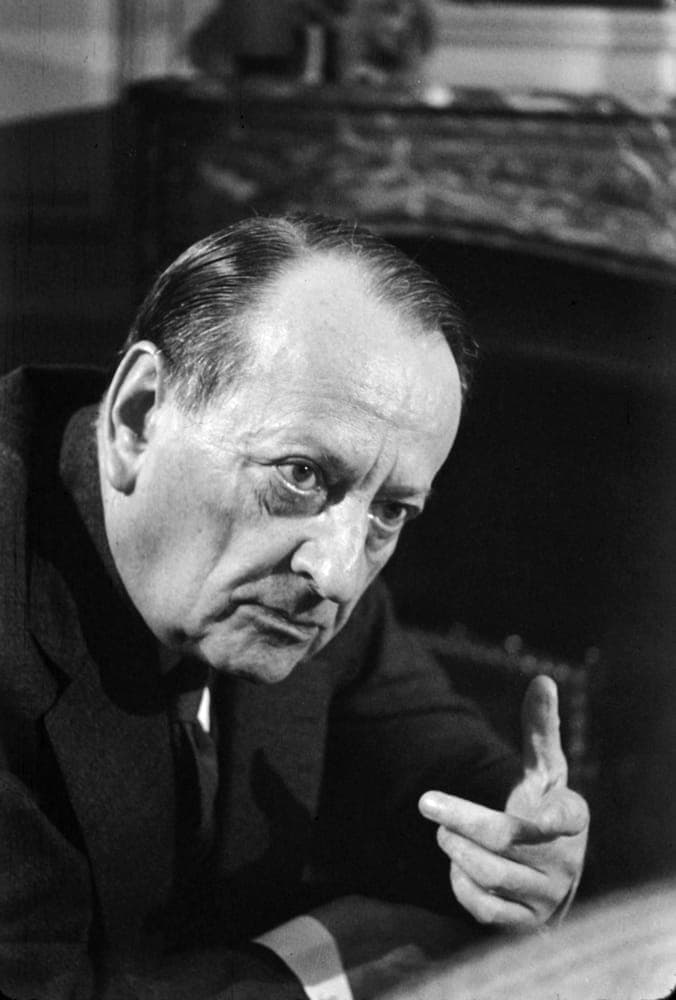
Born Georges André Malraux on November 3, 1901, in Paris, to a stockbroker father who would later die by suicide and a Berthe Lamy whose marriage ended when the boy was four, he was raised in the Seine suburb of Bondy above his maternal grandmother's grocery store. He left school at eighteen and worked the Paris bookstalls, reading his way into the orbit of Max Jacob, Cocteau, and the surrealists. At twenty-two he sailed for Indochina to hack ancient Khmer reliefs from the temple of Banteay Srei, was arrested by the French colonial authorities, given a three-year sentence, and saved by a petition signed by Gide, Mauriac, and Aragon. He returned a writer with an adopted persona of intellectual adventurer in the mould of his hero T. E. Lawrence. The Conquerors (1928), The Royal Way (1930), and above all La Condition Humaine (1933), set during the 1927 Shanghai uprising and a near-elegy for the defeated communist insurgents, won him the Prix Goncourt at thirty-one. He led an international squadron of pilots for the Spanish Republic, distilled the experience into L'Espoir (1937), and joined the Resistance under the nom de guerre Colonel Berger, commanding the Alsace-Lorraine Brigade in 1944. After the war he abandoned the novel for art history, becoming de Gaulle's information minister in 1945 and France's first minister of cultural affairs from 1959 to 1969. He cleaned the blackened façades of Paris and gave the country its Maisons de la Culture. He died of a lung embolism in Créteil on November 23, 1976, at seventy-five; in 1996 his ashes were transferred to the Panthéon.
In 1962 Jacqueline Kennedy asked Malraux whether the Mona Lisa might visit America, and he said yes over the protests of Louvre curators who threatened to resign. The painting crossed the Atlantic on the liner France under Secret Service guard, and on January 8, 1963, Malraux stood beside President Kennedy in Washington as it was unveiled.
The first button needs the app on this device; the second gets it there.