
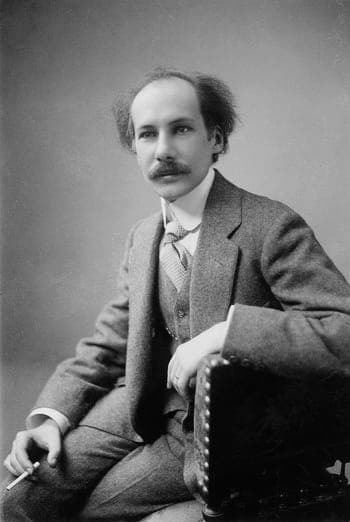
Author
Andrei Bely
- Lived
- Lived 1880 to 1934
- From
- From Russian
- Born in
- Born in Moscow, Russia
Born Boris Nikolayevich Bugaev on October 26, 1880, in Moscow, the only child of Nikolai Bugaev, a mathematics professor at Moscow University and a rigid positivist, and Alexandra, a musical and unstable mother whose warring household left him prone to breakdowns his whole life. Family friend Mikhail Solovyov gave the boy his pen name, Andrei Bely, so his father's mathematical reputation would not be embarrassed by a son writing mystical verse. Bely studied mathematics himself at Moscow University while publishing Symphony (2nd, Dramatic) in 1902, an experimental prose-poem that announced Russian Symbolism's arrival, and soon became, with Alexander Blok, its central figure; the two men's friendship curdled into a years-long rivalry after Bely fell in love with Blok's wife, Lyubov Mendeleeva. The Silver Dove (1910), a novel about a poet destroyed by a peasant sect, established him as a major prose stylist, and Petersburg, serialized in 1913 and revised for its definitive 1922 Berlin edition, became his masterwork, a hallucinatory novel of a father, a son, and a terrorist's bomb that Vladimir Nabokov later ranked among the century's essential fictions. In 1914 Bely married Asya Turgeneva and moved to Dornach, Switzerland, spending two years carving wood for Rudolf Steiner's Goetheanum and deepening a lifelong commitment to anthroposophy. He returned to wartime Russia in 1916, lived through revolution and civil war, and spent 1921 to 1923 in Berlin exile before coming back to the Soviet Union, where he married Klavdia Vasilyeva and worked increasingly under ideological suspicion. In July 1933, while staying at the Black Sea resort of Koktebel, he suffered a severe sunstroke that brought on a cerebral hemorrhage. He never fully recovered, and died in Moscow on January 8, 1934, at fifty-three; his death mask was cast the same day, and an admiring obituary from fellow writers drew official disapproval for its unorthodox warmth.
In March 1914, Bely arrived in Dornach, Switzerland, and set down his pen for a chisel. For two years he carved wooden columns and architraves for Rudolf Steiner's Goetheanum, sitting in on lectures in the half-finished woodworking hall while the First World War burned across the rest of Europe.
The first button needs the app on this device; the second gets it there.
In the canon
- Petersburg1913