
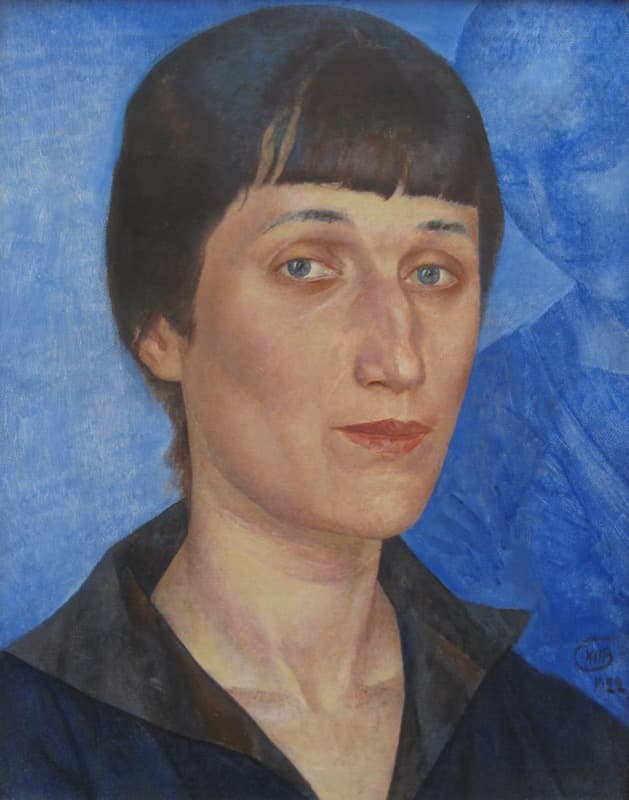
Author
Anna Akhmatova
- Lived
- Lived 1889 to 1966
- From
- From Russian
- Born in
- Born in Bolshoy Fontan, near Odessa
Born Anna Andreyevna Gorenko in 1889 in Bolshoy Fontan, near Odessa, she adopted the surname Akhmatova from a Tatar great-grandmother because her father forbade her to disgrace the family name with poetry. At twenty-one she married the poet Nikolai Gumilev, and her first collection, Evening (1912), announced a voice of startling intimacy that broke from the symbolist haze then dominant in Russian verse. Rosary (1914) made her the most popular poet in Russia. The revolution destroyed everything: Gumilev was executed by the Bolsheviks in 1921, her son Lev was arrested repeatedly and spent fourteen years in the Gulag, and her work was banned under a 1946 decree by Andrei Zhdanov that called her "half nun, half harlot." For sixteen years she published almost nothing. She composed Requiem (1935-1940), her cycle of poems about the Terror, largely in secret, memorizing lines and burning manuscripts, while friends committed stanzas to memory to ensure the work survived. Poem Without a Hero (1940-1965), her modernist masterwork, occupied her for a quarter century of revision. The ban was partially lifted after Stalin's death, and in 1964 she traveled to Italy to receive the Etna-Taormina Prize, her first trip outside the Soviet Union in decades. She died in a sanatorium near Moscow on March 5, 1966, and thousands lined the streets of Leningrad for her funeral.
In the Yezhov terror she stood seventeen months in the prison queues of Leningrad, where her son was held. A woman with lips blue from cold, who had never heard her called by name, whispered: 'Can you describe this?' Akhmatova answered, 'I can.' Something like a smile passed over what had once been the woman's face.
The first button needs the app on this device; the second gets it there.
In the canon
- Song of the Last Meeting1911
- Lot's Wife1924
- A Poem Without A Hero1960
- Requiem1963