
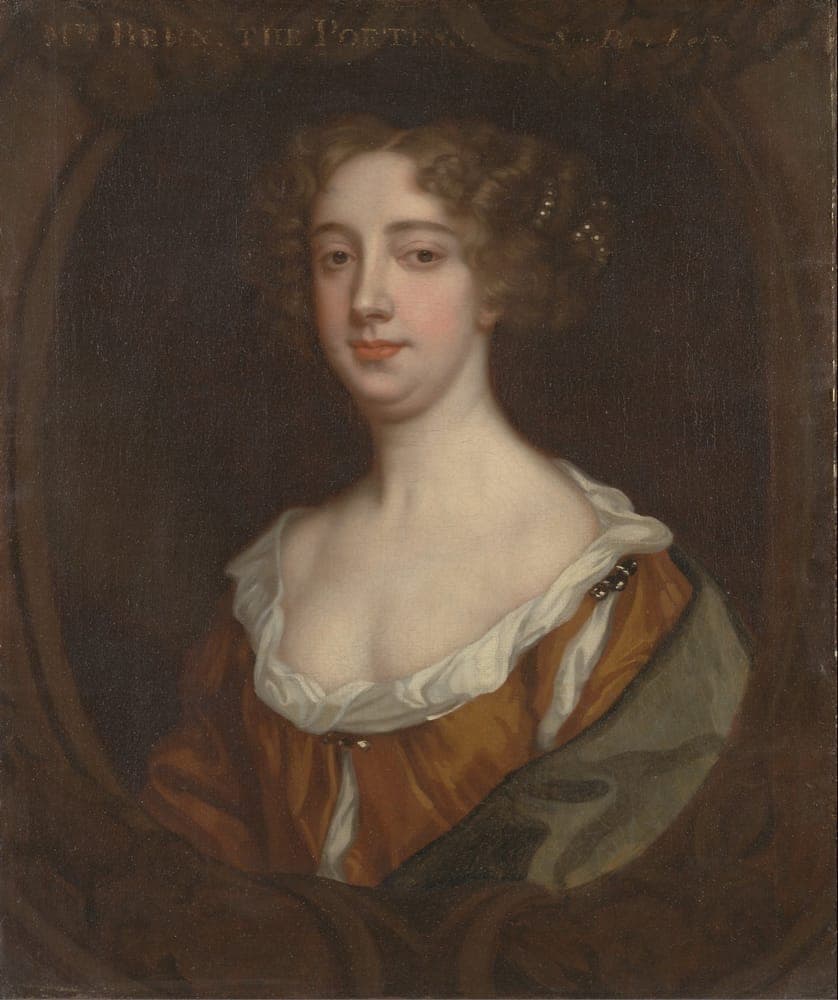
Author
Aphra Behn
- Lived
- Lived 1640 to 1689
- From
- From English
Born most likely in 1640, probably in Wye or Canterbury, in Kent, Aphra Behn entered a world that left almost no record of her origins, and she guarded the gaps herself. Her early life is a tissue of plausible accounts. As a young woman she traveled to the English colony of Surinam, an experience she later drew on directly. By 1666 she was in the Low Countries working as a spy for Charles II during the Second Anglo-Dutch War, dispatching coded reports under the cipher name Astrea, a name she kept for her writing. The crown paid her so poorly that she returned to London in debt and may have spent time in debtors' prison. She turned to the stage to live, and from 1670 her plays filled the Restoration theaters: The Forc'd Marriage (1670), The Rover (1677), a comedy of exiled cavaliers in Naples that became her most popular work, and The Lucky Chance (1686). She wrote prolifically, around nineteen plays, alongside poems and translations, defending her right as a woman to earn by her pen. Oroonoko (1688), her short novel of an enslaved African prince in Surinam, drew on her own time there and is often counted among the earliest English novels. She answered charges of bawdiness with the observation that her plays were judged harshly only because their author was a woman. She died on April 16, 1689, and was buried in the cloisters of Westminster Abbey, her stone inscribed with a couplet on mortality and wit. Virginia Woolf later wrote that all women should let flowers fall upon her grave.
The first button needs the app on this device; the second gets it there.
In the canon
- Love-Letters Between a Nobleman and His Sister1684
- Oroonoko1688