
Author
Aristotle
- Lived
- Lived 384 BCE to 322 BCE
- From
- From Ancient Greek
- Born in
- Born in Stagira, Greece
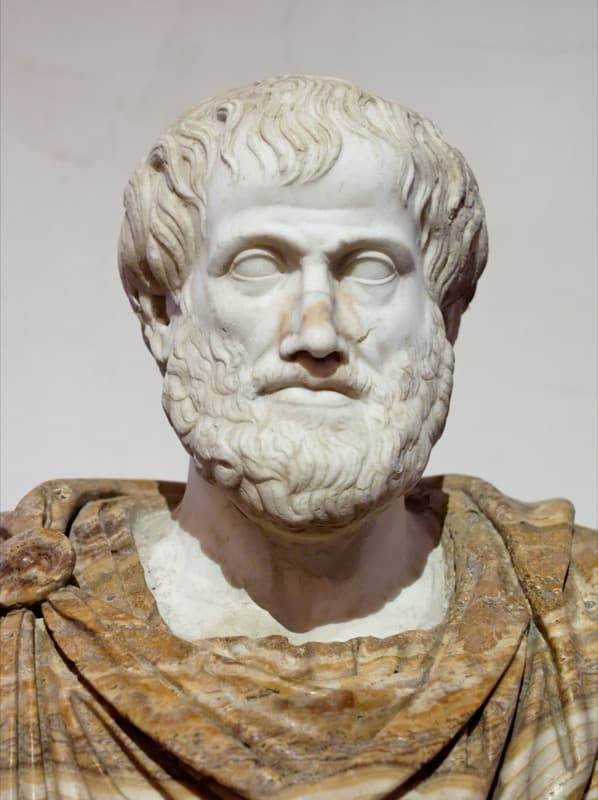
Born in 384 BC in Stagira, a small Greek colony near the Macedonian border, Aristotle was the son of Nicomachus, personal physician to the Macedonian king Amyntas III. Orphaned young, he was sent at seventeen to Plato's Academy in Athens, where he remained for twenty years as student and teacher until Plato's death in 347 BC. Passed over to lead the Academy, he left Athens and spent years traveling, to Assus in Asia Minor, to the island of Lesbos, where he conducted pioneering studies of marine biology, before Philip II of Macedon summoned him to tutor the thirteen-year-old Alexander. In 335 BC he returned to Athens and founded the Lyceum, where he walked the covered walkway as he lectured, earning his students the name Peripatetics. Over the next twelve years he produced an astonishing range of works: the Nicomachean Ethics, the Politics, the Poetics, the Physics, the Metaphysics, De Anima, the Prior Analytics (which invented formal logic), and detailed studies of animals, constitutions, rhetoric, and weather. The surviving texts, probably lecture notes rather than polished books, are dense and compressed but cover virtually every field of inquiry the ancient world recognized. When Alexander died in 323 BC and anti-Macedonian sentiment swept Athens, Aristotle fled to Chalcis on Euboea, saying he would not allow Athens to sin twice against philosophy. He died there the following year, aged sixty-two, leaving a will that freed his slaves and provided for his companion Herpyllis.
On the lagoon at Lesbos, Aristotle waded and dissected. He recorded that the dogfish carries its young inside the mother, joined by a cord to something like a placenta. The claim sounded absurd for more than two thousand years, until a German anatomist confirmed it, exactly as written, in 1842.
The first button needs the app on this device; the second gets it there.
In the canon
- Nicomachean Ethics350 BCE
- The Politics350 BCE
- De Anima350 BCE
- Prior Analytics350 BCE
- Physics350 BCE
- Metaphysics347 BCE
- The Athenian Constitution330 BCE
- Poetics322 BCE
- Corpus Aristotelicum322 BCE
- Rhetoric322 BCE