
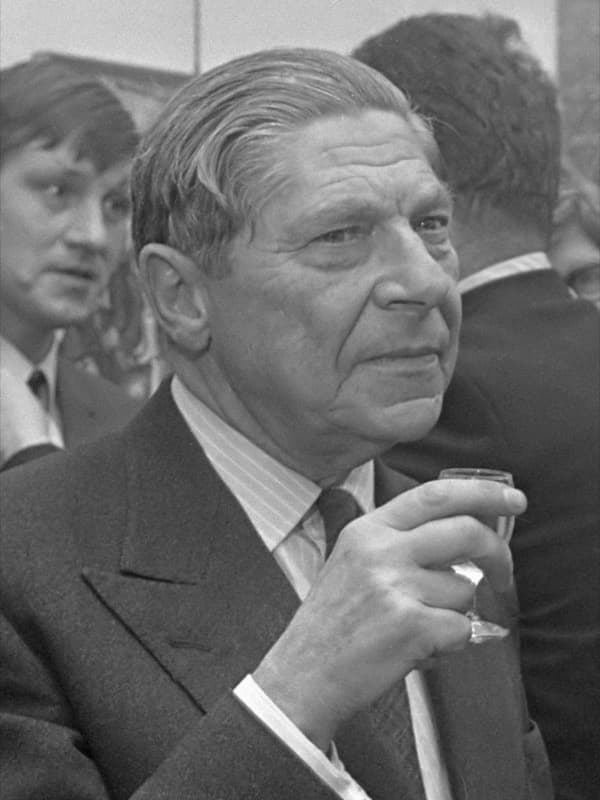
Author
Arthur Koestler
- Lived
- Lived 1905 to 1983
- From
- From Hungarian-British
- Born in
- Born in Budapest, Austria-Hungary
Born in 1905 in Budapest to a Hungarian father and Viennese mother, Koestler grew up amid the collapse of the Austro-Hungarian Empire and never quite belonged to any single country. He studied engineering and science in Vienna, dropped out before finishing, and drifted into journalism, becoming a foreign correspondent who reported from the Middle East, Paris, and Berlin. In 1931 he joined the Communist Party, convinced it offered the only answer to fascism, and during the Spanish Civil War was captured by Franco's forces and sentenced to death, spending three months in a Seville prison expecting execution each dawn. That experience broke his faith in ideology. Darkness at Noon (1940), his masterpiece, written in German and translated into English from a manuscript the original of which was lost for decades, dramatized the Moscow show trials through the confession of an old Bolshevik and became the most devastating fictional indictment of totalitarianism ever published. The God That Failed (1949) collected his essay alongside those of other disillusioned ex-Communists. He turned restlessly to science, philosophy, and psychology, producing The Sleepwalkers (1959) and The Act of Creation (1964). On March 1, 1983, suffering from Parkinson's disease and leukemia, Koestler took his own life in London alongside his wife Cynthia, a final act of control that provoked as much controversy as his writing ever had.
In 1940, as the German army swept through France, Koestler and his translator, Daphne Hardy, raced to finish Darkness at Noon before fleeing Paris. She posted her English manuscript to London days before the invasion reached them, and in the panic of escape, his original German pages vanished, along with any memory of the forgotten carbon copy in Zurich.
I wish my friends to know that I am leaving their company in a peaceful frame of mind, with some timid hopes for a de-personalised after-life beyond due confines of space, time and matter and beyond the limits of our comprehension. This oceanic feeling has often sustained me at difficult moments, and does so now, while I am writing this.
The first button needs the app on this device; the second gets it there.
In the canon
- Darkness at Noon1940
- Scum of the Earth1941
- Arrival and Departure1943
- The God That Failed1949
- The Sleepwalkers1959
- The Act of Creation1964