
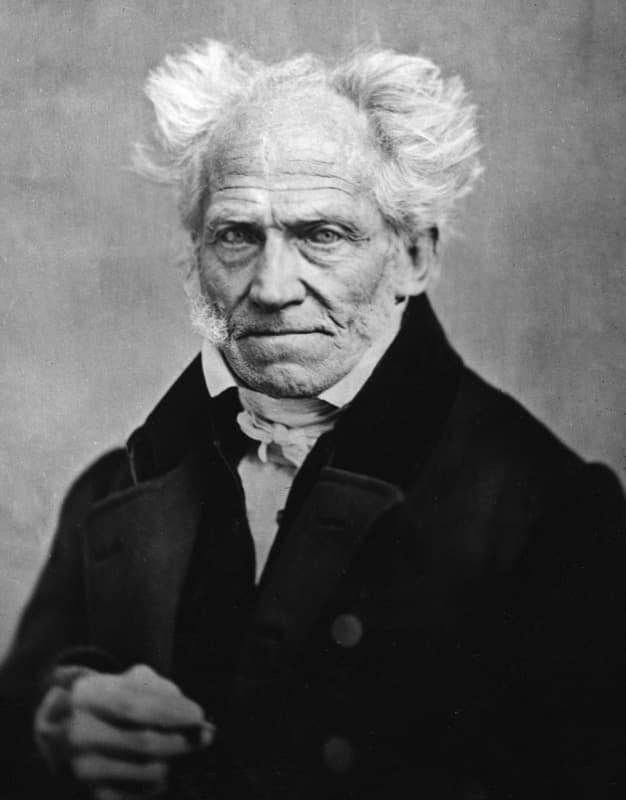
Author
Arthur Schopenhauer
- Lived
- Lived 1788 to 1860
- From
- From German
- Born in
- Born in Danzig (now Gdańsk, Poland)
Born in 1788 in Danzig to a wealthy merchant father and a mother who became a successful novelist, Schopenhauer was groomed for commerce but repelled by it. His father, who may have suffered from severe depression, drowned in a Hamburg canal in 1805 in what was likely a suicide, leaving the young Schopenhauer a private income that freed him from ever needing to earn a living. He studied philosophy at Gottingen and Berlin, completing his doctorate at twenty-five with On the Fourfold Root of the Principle of Sufficient Reason (1813). His masterwork, The World as Will and Representation (1818), argued that the fundamental reality behind all phenomena was a blind, striving, purposeless force he called Will, and that human existence was therefore inherently suffused with suffering. The book sold so poorly that most copies ended up as waste paper. He notoriously scheduled his lectures at the University of Berlin to compete directly with Hegel's and attracted almost no students. For decades he lived in bitter obscurity in Frankfurt with a succession of poodles, writing Parerga and Paralipomena (1851), the collection of essays and aphorisms that finally brought him fame in old age. His influence proved immense, shaping Nietzsche, Wagner, Freud, Wittgenstein, and Tolstoy. He died in 1860, found sitting upright on his sofa by his housekeeper, breakfast untouched.
In 1821 Schopenhauer, enraged by a seamstress chattering outside his Berlin door, shoved her down the stairs. She sued for lasting injury, and after six years a court ordered him to pay her a pension for life. He paid it for fifteen years. When she died, he noted in his ledger, in Latin: the old woman dies, the burden departs.
The first button needs the app on this device; the second gets it there.
In the canon
- On the Fourfold Root of the Principle of Sufficient Reason1813
- The World as Will and Representation1818
- The World as Will and Idea1818
- On the Basis of Morality1840
- Essays and Aphorisms1851
- On Noise1851
- Parerga and Paralipomena1851