
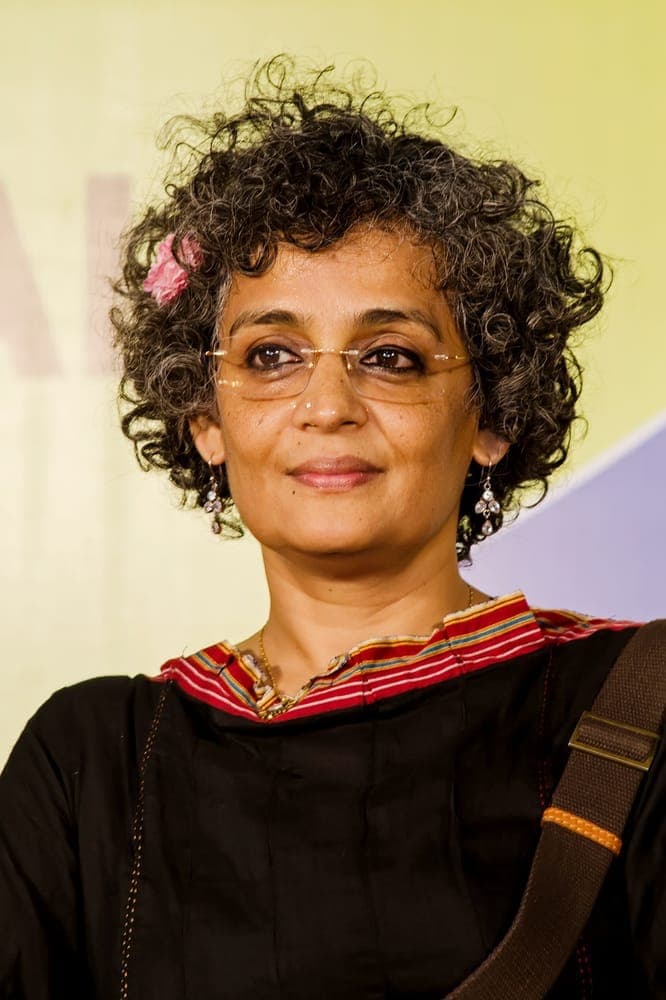
Author
Arundhati Roy
- Lived
- Lived born 1961
- From
- From Indian
- Born in
- Born in Shillong, India
Born Suzanna Arundhati Roy on November 24, 1961, in Shillong, in what is now Meghalaya, India, she was the daughter of a Bengali Hindu tea plantation manager and Mary Roy, a Malayali Christian women's rights activist from Kerala. Her parents divorced when she was two, and she was raised in Kerala by her mother, who founded a school in the village of Aymanam. At sixteen she left home, lived in a squatter's hut in Delhi, and studied architecture at the School of Planning and Architecture, where she also met her first husband. She drifted into film, acted in Massey Sahib (1985), and won the National Film Award for Best Screenplay in 1988 for In Which Annie Gives It Those Ones, directed by her second husband, the filmmaker Pradip Krishen. She began The God of Small Things in 1992 and finished it in 1996, drawing on the Aymanam of her childhood, the long-lashed sorrow of the twins Estha and Rahel, and a forbidden river crossing whose consequences ripple back across decades. It was published in 1997 and won the Booker Prize that year, sold in eighteen countries by the end of June, and became the biggest-selling book by a non-expatriate Indian author. She has spent the decades since as a political essayist and activist, opposing the Narmada dam project, nuclear testing, and the Indian state's policies in Kashmir, and was charged with sedition in 2010 for remarks she made in support of Kashmiri independence. Her second novel, The Ministry of Utmost Happiness, appeared in 2017, twenty years after her first. She lives in Delhi and won the PEN Pinter Prize in 2024.
In early 1996, Roy sent her finished manuscript to the young Delhi publisher Pankaj Mishra. He read it on a train, grew so excited he broke the journey to telephone his congratulations, then passed it on to the London agent David Godwin, who flew to India and signed her within four days.
The first button needs the app on this device; the second gets it there.
In the canon
- The God of Small Things1997