
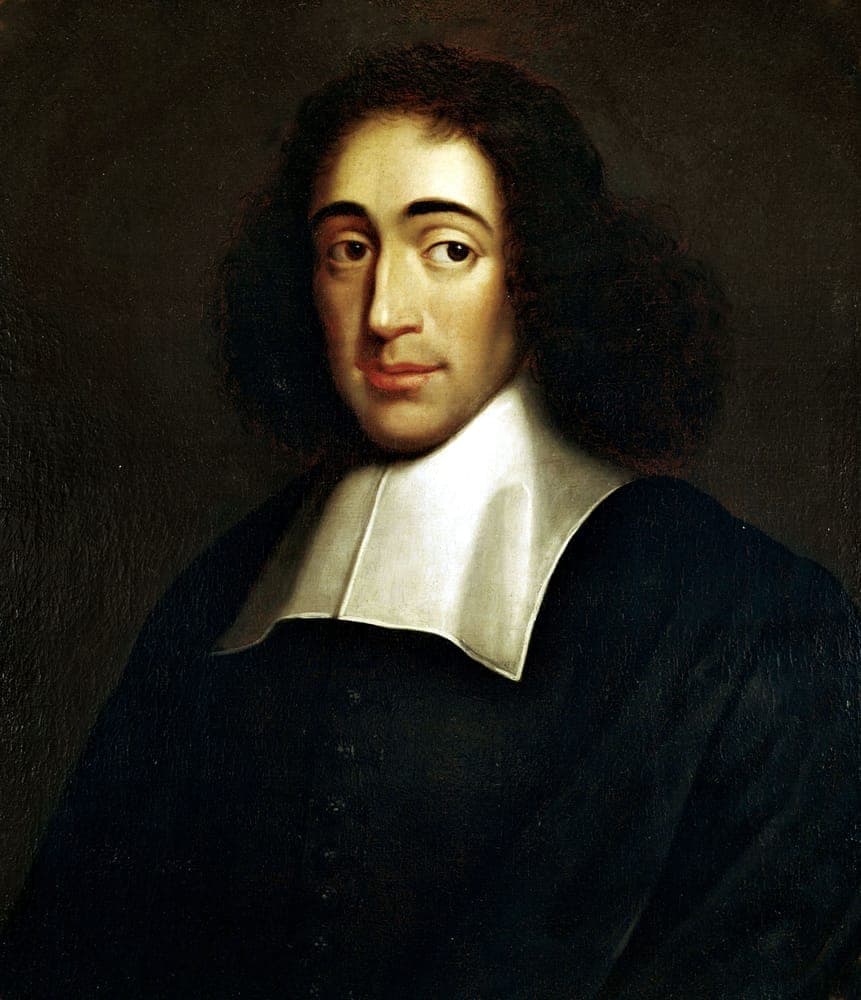
Author
Baruch de Spinoza
- Lived
- Lived 1632 to 1677
- From
- From Dutch
- Born in
- Born in Amsterdam, Dutch Republic
Born on 24 November 1632 in Amsterdam to a Portuguese-Jewish family that had fled the Inquisition for the more tolerant Dutch Republic, Baruch Spinoza was the third child of Michael, a prominent merchant in the Talmud Torah congregation, and Hannah Deborah, who died when the boy was six. He studied at the synagogue's Talmud Torah school and learned Hebrew, Spanish, and Portuguese, but left formal schooling around fourteen to help in his father's import business. On 27 July 1656, when he was twenty-three, the Amsterdam congregation issued the harshest writ of herem in its history against him for abominable heresies and monstrous deeds; he was excommunicated permanently, and the censure was never rescinded. He took the Latin name Benedictus, settled outside Amsterdam in Rijnsburg and later in the Hague, learned Latin from the radical Franciscus van den Enden, and supported himself grinding lenses for telescopes and microscopes while gathering a small circle of correspondents and friends. The Tractatus Theologico-Politicus (1670), published anonymously, argued for freedom of thought and against the divine origin of the Hebrew Bible, and was promptly banned. Ethics, completed in the early 1670s, set out a pantheist God identical with Nature in the geometric form of Euclid's Elements; he kept it from the press to avoid persecution. He declined a chair at Heidelberg in 1673 to protect his liberty of thought. He never married and lived simply on a small pension. He died at the Hague on 21 February 1677, aged forty-four, of a lung complaint probably worsened by years of inhaling glass dust. His friends published Ethics and the unfinished Tractatus Politicus later the same year.
In July 1656, twenty-three-year-old Spinoza stood before the Amsterdam synagogue as the elders read out a herem, a curse pronounced by day and by night, cursing him lying down and rising up, forbidding any Jew ever again to read a line he wrote or speak to him.
The first button needs the app on this device; the second gets it there.
In the canon
- Tractatus Theologico Politicus1670
- Ethics1677