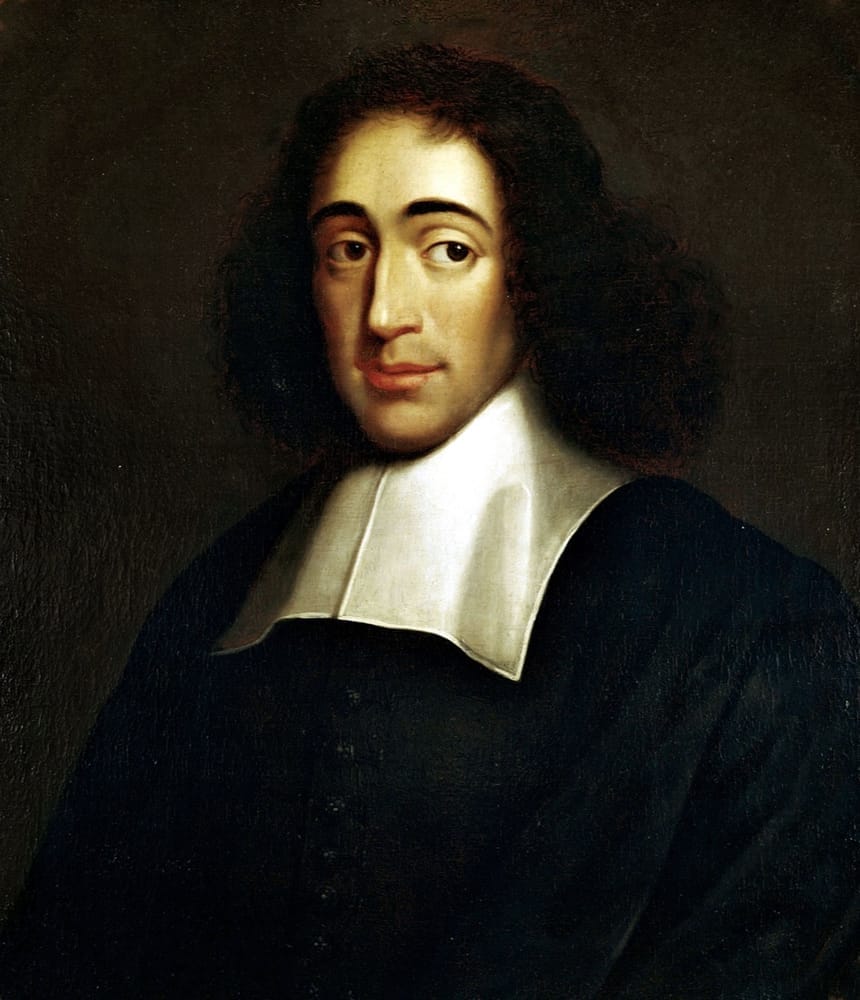
Benedict de Spinoza
Dutch · 1632 to 1677
Born Baruch Spinoza on November 24, 1632, in Amsterdam, he was the son of Portuguese Sephardic Jews who had fled the Inquisition for the relative tolerance of the Dutch Republic. He was raised in the close world of the Talmud Torah congregation, schooled in Hebrew and the rabbinic commentaries, and groomed for a life in the family import business, which he ran for a time after his father's death. He read widely beyond the synagogue, in Descartes and in the radical scholars of his day, and his questions grew dangerous. In 1656, at twenty-three, the Amsterdam synagogue issued against him the harshest writ of cherem in its records, banishing him for "abominable heresies" and forbidding any Jew to speak with him or read his writing. He never converted, took the Latin name Benedictus, and supported himself by grinding optical lenses, the fine glass dust of which slowly ruined his lungs. He lived quietly in rented rooms outside Leiden and at The Hague, declining a professorship at Heidelberg to keep his independence. His Principles of Cartesian Philosophy (1663) was the only book published under his own name in his lifetime. The Theological-Political Treatise (1670), issued anonymously, argued for freedom of thought and read scripture as a human document, and was promptly condemned as a work forged in hell. His masterpiece, the Ethics, written in the austere form of geometric proofs, identifies God with Nature and traces a path from bondage to blessedness through understanding; he withheld it from print, fearing prosecution. He died on February 21, 1677, at The Hague, aged forty-four. The Ethics appeared months later in his posthumous works, his name reduced to the initials B.D.S.