
Author
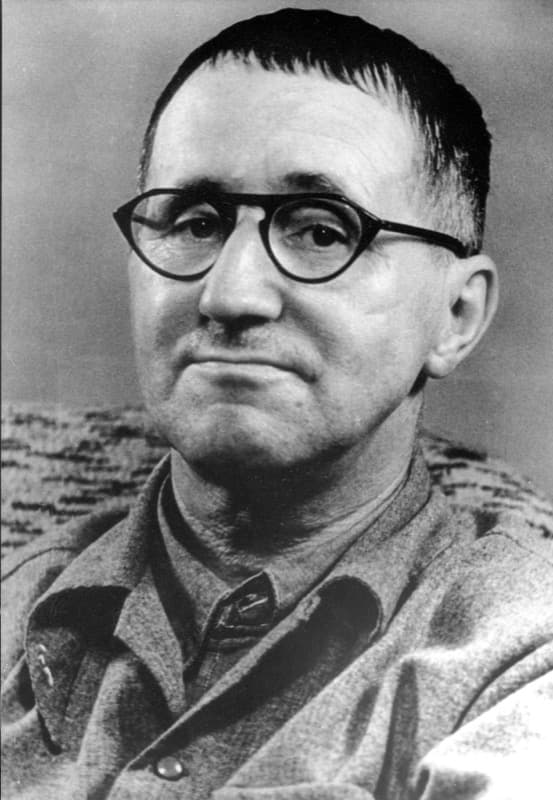
Bertolt Brecht
- Lived
- Lived 1898 to 1956
- From
- From German
- Born in
- Born in Augsburg, Germany
Born in 1898 in Augsburg, Bavaria, to a prosperous family, his father managed a paper mill, Brecht showed an early talent for provocation, nearly expelled from school for an antiwar essay during the First World War. He studied medicine in Munich but spent more time in cabarets than lecture halls, and his first play, Baal (1918), scandalized audiences with its amoral poet-hero. The Threepenny Opera (1928), written with composer Kurt Weill, became a sensation in Weimar Berlin, its knife-twisting songs about criminals doubling as indictments of capitalism. When the Reichstag burned in 1933, Brecht fled Germany the next day, beginning fifteen years of exile through Denmark, Finland, and finally Los Angeles. During these years he wrote his greatest plays, Mother Courage and Her Children (1939), The Good Person of Szechwan (1943), The Caucasian Chalk Circle (1948), developing his theory of epic theater, which demanded that audiences think rather than feel. Hauled before the House Un-American Activities Committee in 1947, he outwitted his interrogators and left for Europe the next day. He settled in East Berlin, where the state gave him his own company, the Berliner Ensemble, and he gave the state a cultural jewel while privately despising its bureaucrats. He died of a heart attack in 1956 at fifty-eight.
In 1915, given a school assignment to explain why it is sweet to die for one's country, the seventeen-year-old Brecht wrote instead that only an empty-headed person could believe it, calling the sentiment cheap propaganda. The essay nearly got him expelled. Only a sympathetic priest, filling in as his teacher, intervened and saved his place.
The first button needs the app on this device; the second gets it there.
In the canon
- Baal1918
- The Threepenny Opera1928
- Threepenny Novel1934
- A Worker Reads History (Fragen eines lesenden Arbeiters)1935
- Galileo1938
- Mother Courage and Her Children1941
- The Resistible Rise of Arturo Ui1941
- The Good Person of Szechwan1943
- Life of Galileo1943
- The Caucasian Chalk Circle1944