
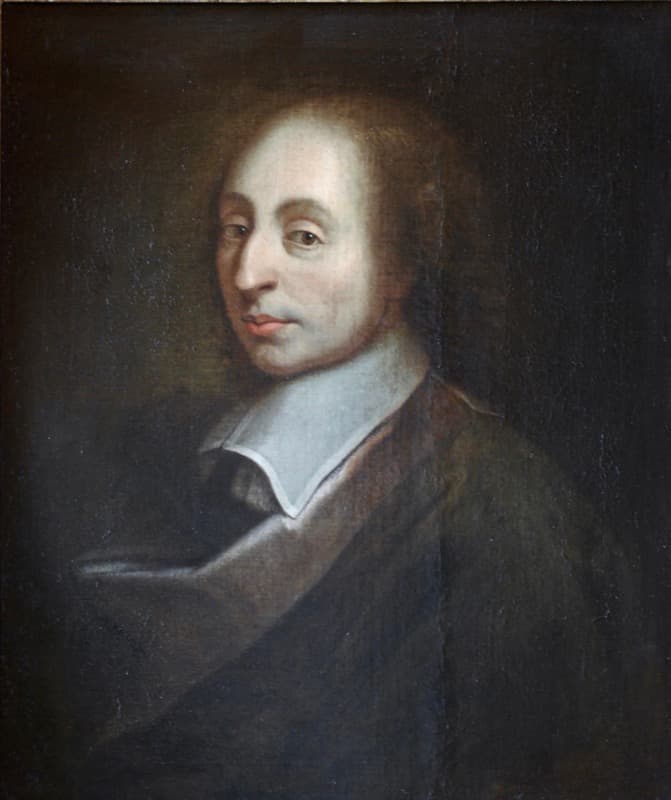
Author
Blaise Pascal
- Lived
- Lived 1623 to 1662
- From
- From French
- Born in
- Born in Clermont-Ferrand, France
Born in 1623 in Clermont-Ferrand, France, Pascal lost his mother at age three and was educated entirely by his father, a tax official and amateur mathematician who moved the family to Paris. The boy was a prodigy of almost frightening intensity: at sixteen he published a treatise on conic sections that astonished Descartes, and at nineteen he invented the Pascaline, one of the first mechanical calculators, to ease his father's accounting burden. His experiments on the vacuum and hydraulic pressure made him one of the foremost scientists in Europe before he turned thirty. Then, on the night of November 23, 1654, he experienced what he called his "night of fire", a mystical encounter with God that he recorded on a scrap of parchment sewn into the lining of his coat and carried until his death. He abandoned science for theology, entering the orbit of the Jansenists at Port-Royal. The Provincial Letters (1656-1657), his devastating attack on Jesuit casuistry, invented modern French prose satire. The Pensees, published posthumously in 1670, was meant to be a defense of Christianity but survives as a collection of fragments, some a single sentence, some pages long, that constitute one of the most anguished meditations on faith, reason, and the wretchedness of man without God. He died in 1662 at thirty-nine, having spent his last years in voluntary poverty, giving his money to the poor.
In 1654 a gambler's puzzle reached him: if a game of chance is broken off unfinished, how should the stakes be fairly split? That summer, in an exchange of letters with Pierre de Fermat, Pascal worked out how to weigh an uncertain future, and the mathematics of probability was born.
May God never abandon me.
The first button needs the app on this device; the second gets it there.
In the canon
- The Provincial Letters1656
- Pensées1670