
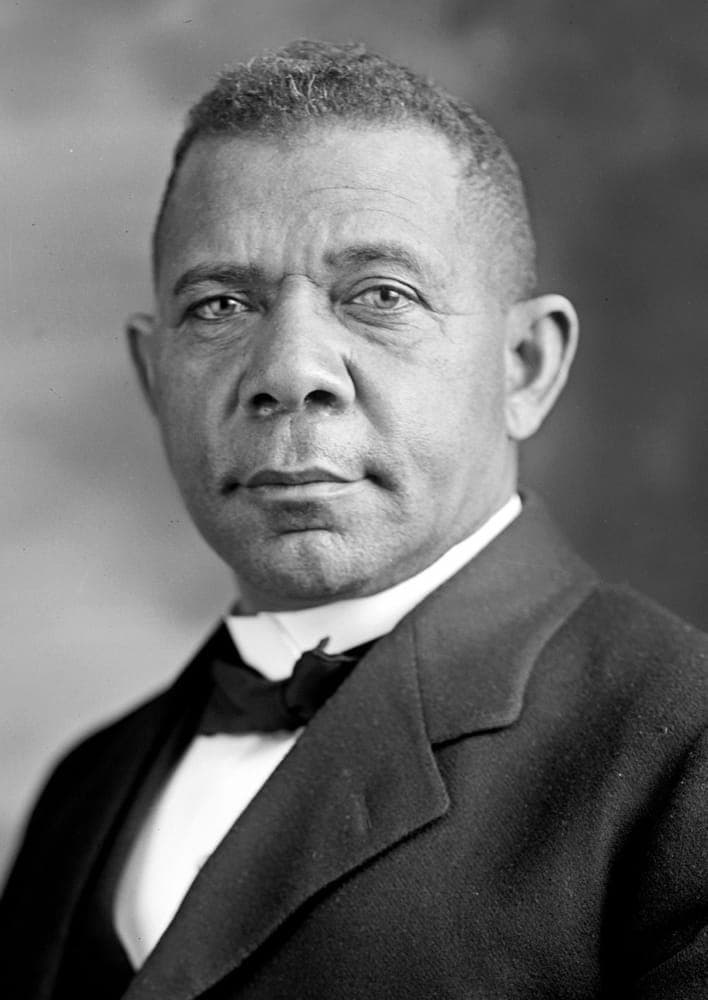
Author
Booker T. Washington
- Lived
- Lived 1856 to 1915
- From
- From American
- Born in
- Born in Hale's Ford, Virginia
Born into slavery on April 5, 1856, on a tobacco plantation in Hale's Ford, Virginia, Booker Taliaferro Washington never knew his white father and spent his earliest years sleeping on a dirt floor in a one-room cabin. Emancipation freed him at nine, and the family moved to Malden, West Virginia, where the boy packed salt and worked the coal mines while teaching himself letters from a borrowed spelling book. At sixteen he walked much of the five hundred miles to Hampton Institute, sweeping a recitation room so thoroughly that the head teacher admitted him on the spot. In 1881 he was sent to found a normal school for Black students in an Alabama town called Tuskegee, beginning in a leaky church with thirty pupils and building it, brick by student-made brick, into a national institution. His Atlanta address of 1895, urging Black self-help and accommodation with the white South, made him the most powerful Black leader of his era and drew the lasting opposition of W. E. B. Du Bois. He dined at the White House with Theodore Roosevelt in 1901, the first Black man so received, and quietly funded legal challenges to disenfranchisement while preaching patience in public. His memoir Up from Slavery (1901) became one of the best-selling American autobiographies, translated into many languages. He also wrote The Future of the American Negro (1899) and The Story of My Life and Work (1900). He died of exhaustion and heart failure on November 14, 1915, at fifty-nine, in Tuskegee, having insisted on returning home from a New York hospital to die in the place he had built.
In 1895, before thousands of spectators at the Atlanta Exposition, Washington delivered the speech that made him the nation's most powerful Black leader overnight. He urged the races toward cooperation through labor rather than agitation, coining an image of casting down one's bucket exactly where one stood.
The first button needs the app on this device; the second gets it there.
In the canon
- Up from Slavery1901