
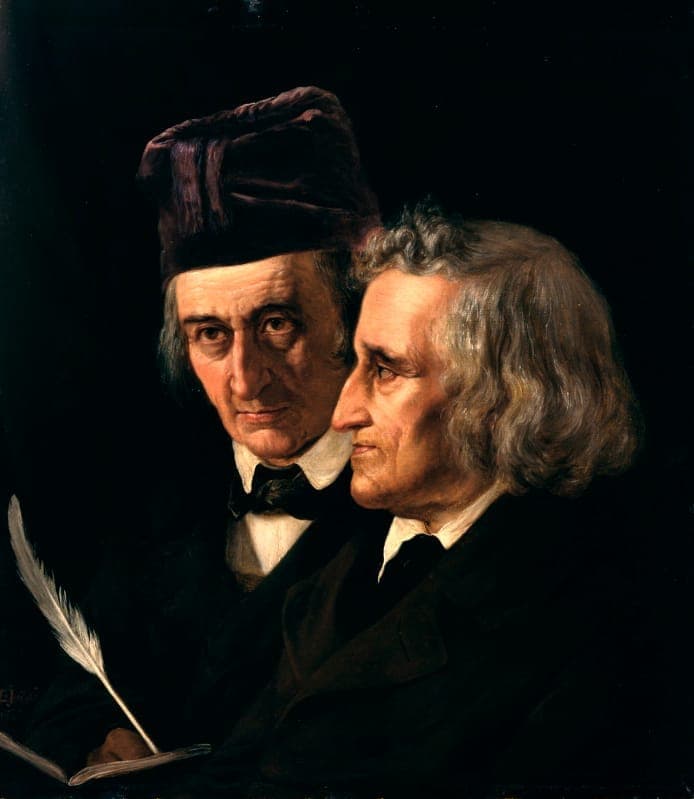
Author
Brothers Grimm
- Lived
- Lived 1785 to 1863
- From
- From German
- Born in
- Born in Hanau, Germany
Born in Hanau in the Landgraviate of Hesse-Kassel, Jacob (4 January 1785) and Wilhelm (24 February 1786) Grimm were the elder surviving sons of Philipp Wilhelm Grimm, a jurist, and Dorothea Zimmer, raised in the countryside town of Steinau where their father served as district magistrate. Their father died of pneumonia in 1796, plunging the family into sudden poverty; Jacob, aged eleven, took on the role of head of the household. At Marburg University, the law professor Friedrich von Savigny awakened in the brothers a passion for medieval German literature, and through Savigny they met the Romantics Clemens Brentano and Achim von Arnim. Working as librarians in Kassel, they began gathering folk tales from educated, urban acquaintances, publishing the first volume of Kinder- und Hausmärchen in 1812. Across seven editions the collection grew from 86 to over 200 stories, fixing the canonical shapes of Cinderella, Hansel and Gretel, Rapunzel, Rumpelstiltskin, and Snow White. Alongside the tales they produced studies of German legends, Norse mythology, and Jacob's German Mythology (1835). In 1837 the brothers were dismissed from the University of Gottingen as members of the protesting Gottingen Seven, having refused to swear an oath to the King of Hanover. In 1838 they began the Deutsches Worterbuch, a historical dictionary so vast it would not be completed until 1961. Wilhelm died of an infection in Berlin on 16 December 1859, aged seventy-three. Jacob, increasingly reclusive, worked on the dictionary until his own death on 20 September 1863, aged seventy-eight. Jack Zipes notes that the last word they reached together was Frucht, meaning fruit.
In January 1796, their father, a Steinau district magistrate, died of pneumonia at forty-four, and the family's income, house, and servants vanished within months. Jacob, only eleven, became the effective head of the household as the brothers pressed on toward the schooling that eventually carried them to Marburg University and Friedrich von Savigny's library.
The first button needs the app on this device; the second gets it there.
In the canon
- Household Tales1812
- Deutsches Wörterbuch1854