
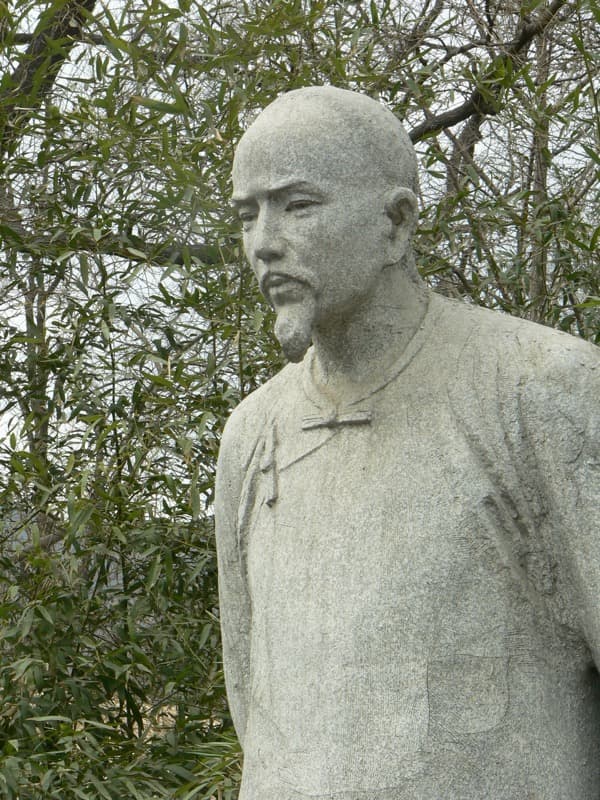
Author
Cao Xueqin
- Lived
- Lived 1715 to 1763
- From
- From Chinese
- Born in
- Born in Nanjing, China
Born around 1715 into the most favored household in the Qing empire, Cao Xueqin grew up in the afterglow of extraordinary privilege. His grandfather Cao Yin had been a childhood companion to the Kangxi Emperor and served as Imperial Textile Commissioner in Nanjing for over two decades, hosting the emperor on four lavish southern tours. The family's fortune evaporated overnight in 1727 when the Yongzheng Emperor seized their estates, jailed Cao's adoptive father Cao Fu, and forced the clan back to Beijing in disgrace. Cao spent the rest of his life in poverty, selling paintings to survive in the countryside west of the capital. There, over a period of at least ten years beginning in the 1740s, he composed Dream of the Red Chamber, a vast, semi-autobiographical novel tracing the decline of a great family through the eyes of its sensitive young heir, Jia Baoyu. Friends recalled a brilliant, generous man who revised the manuscript obsessively, never satisfied with its form. The novel circulated in hand-copied manuscripts during his lifetime, accumulating passionate readers but no publisher. Cao died around 1763 or 1764, probably in his late forties, leaving the work unfinished at eighty chapters. A later editor, Gao E, added forty concluding chapters in 1791. The novel Cao did not live to complete is now regarded as the supreme achievement of Chinese fiction.
Cao spent his last years in the hills west of Beijing, in a poverty his friend Dun Cheng fixed in a single line of verse: the whole family living on porridge, the wine bought on credit. There he revised Dream of the Red Chamber draft after draft, watched it circulate in hand copies, and never saw a printed page.
The first button needs the app on this device; the second gets it there.
In the canon
- Dream of the Red Chamber1791