
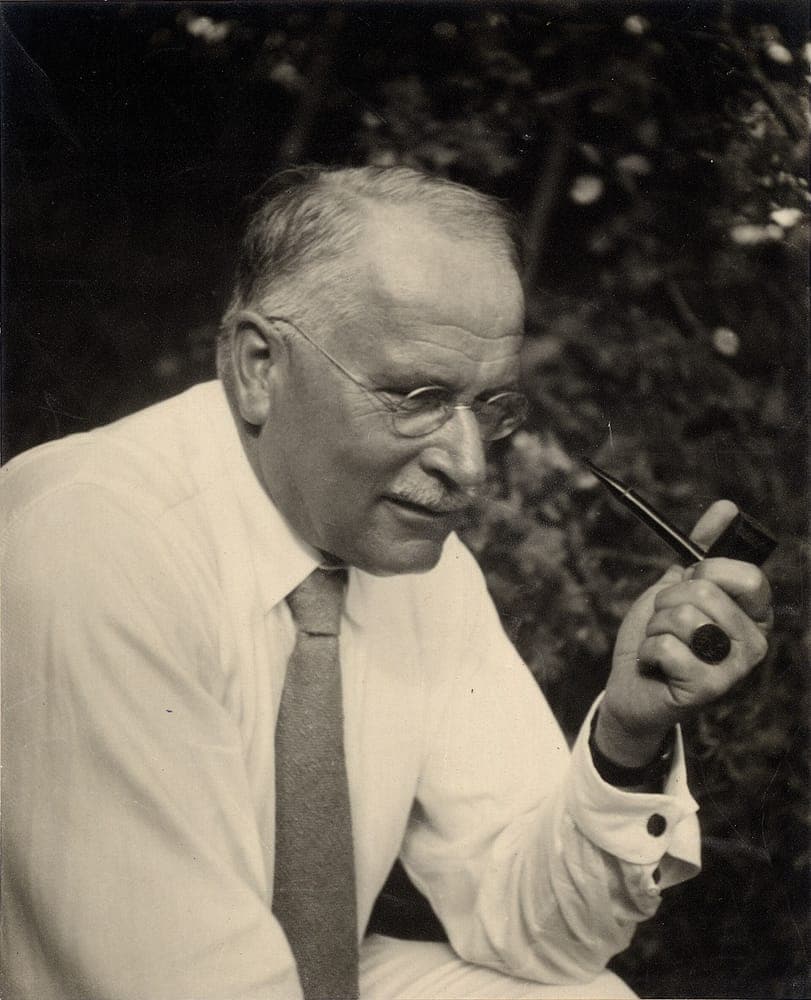
Author
Carl Jung
- Lived
- Lived 1875 to 1961
- From
- From Swiss
- Born in
- Born in Kesswil, Switzerland
Born on July 26, 1875, in Kesswil on Lake Constance, in the Swiss canton of Thurgau, to Paul Jung, a Reformed pastor often poor in spirit, and Emilie Preiswerk, an eccentric and depressive churchman's daughter, Carl Gustav Jung was the first surviving child after two stillbirths and an infant death. Eight of his uncles were clergymen. He grew up at Laufen and then Kleinhüningen near Basel, a solitary boy who carved wooden manikins, kept stones with secret faces, and listened at night for the strange figures he believed visited his mother's room. He read medicine at Basel, took a doctorate in 1902, and joined Eugen Bleuler at the Burghölzli psychiatric hospital in Zurich, where his word-association experiments brought him to the attention of Sigmund Freud. The two men corresponded for six years; Freud chose him as the heir to psychoanalysis and made him first president of the International Psychoanalytical Association in 1910. The break, in 1913, over the libido and the religious imagination, sent Jung into a long inward crisis recorded in his private Red Book. From it came analytical psychology, with its archetypes, its collective unconscious, its individuation, and its synchronicity. He built a stone tower at Bollingen on the upper Zürichsee where he wrote, painted, and cooked over a wood fire. His 1926 treatment of the alcoholic Rowland Hazard led, by a small chain, to the founding of Alcoholics Anonymous. He died at his lakeside house in Küsnacht on June 6, 1961, at eighty-five, the autobiographical Memories, Dreams, Reflections, dictated to his secretary Aniela Jaffé, appearing two years after his death.
In October 1913, travelling alone, Jung was seized by a vision that lasted about an hour: a monstrous flood covering the lands between the North Sea and the Alps, rubble and the drowned bodies of uncounted thousands, and then the whole sea turned to blood. He feared a psychosis was coming. The following August, Europe went to war.
The first button needs the app on this device; the second gets it there.
In the canon
- Psychological Types1921
- Memories, Dreams, Reflections1963
- Man and His Symbols1964