
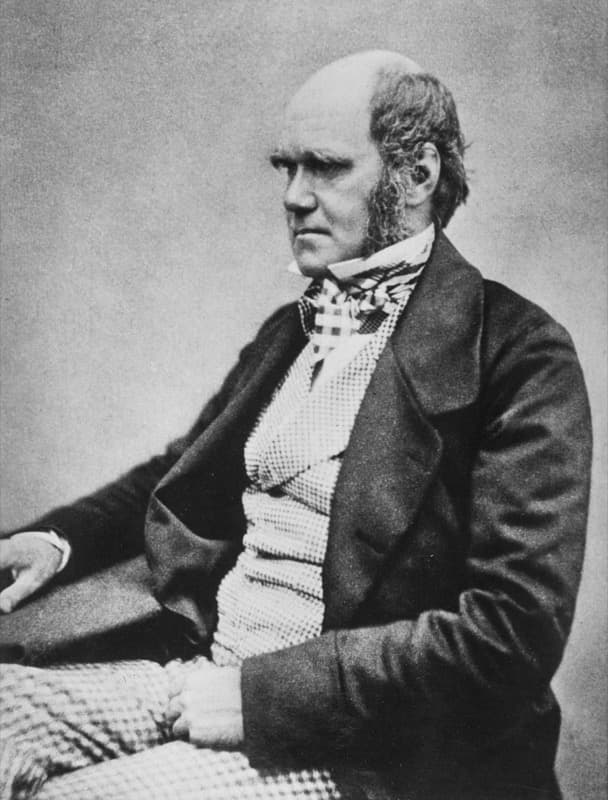
Author
Charles Darwin
- Lived
- Lived 1809 to 1882
- From
- From English
- Born in
- Born in Shrewsbury, England
Born on February 12, 1809, in Shrewsbury, the fifth of six children of a wealthy society physician, Darwin was a mediocre student who preferred collecting beetles to studying medicine at Edinburgh or divinity at Cambridge. His life changed on December 27, 1831, when he sailed from Plymouth aboard HMS Beagle as an unpaid gentleman naturalist on what would become a five-year voyage around the world. The finches of the Galapagos, the fossils of Patagonia, and the coral atolls of the Pacific furnished the raw material for a theory he formulated privately by 1839 but dared not publish, knowing it would overturn the foundations of natural theology. He married his first cousin Emma Wedgwood in January 1839, moved to Down House in rural Kent in 1842, and spent the next two decades as a reclusive experimenter, plagued by a mysterious chronic illness that kept him bedridden for hours each day. Only the arrival of a letter from Alfred Russel Wallace, who had independently conceived the same theory, forced his hand: On the Origin of Species appeared on November 24, 1859, and its first printing of 1,250 copies sold out that day. The Descent of Man (1871) extended the argument to human evolution. He published prolifically on earthworms, orchids, barnacles, and the expression of emotions, producing nineteen books in all. He died on April 19, 1882, and was buried in Westminster Abbey, a few feet from Isaac Newton.
In April 1851 Darwin took Annie, his ten-year-old daughter and the favourite of his children, to Malvern for a water cure. He was at her bedside when she died at midday on the twenty-third. A week later he wrote a private memorial of her: we have lost the joy of the household.
I am not the least afraid of death. Remember what a good wife you have been to me. Tell all my children to remember how good they have been to me.
The first button needs the app on this device; the second gets it there.
In the canon
- The Voyage of the Beagle1839
- On the Origin of Species1859
- The Descent of Man1871
- The Expression of the Emotions in Man and Animals1872
- Autobiographies1887