
Author
C.S. Lewis
- Lived
- Lived 1898 to 1963
- From
- From British
- Born in
- Born in Belfast, Ireland
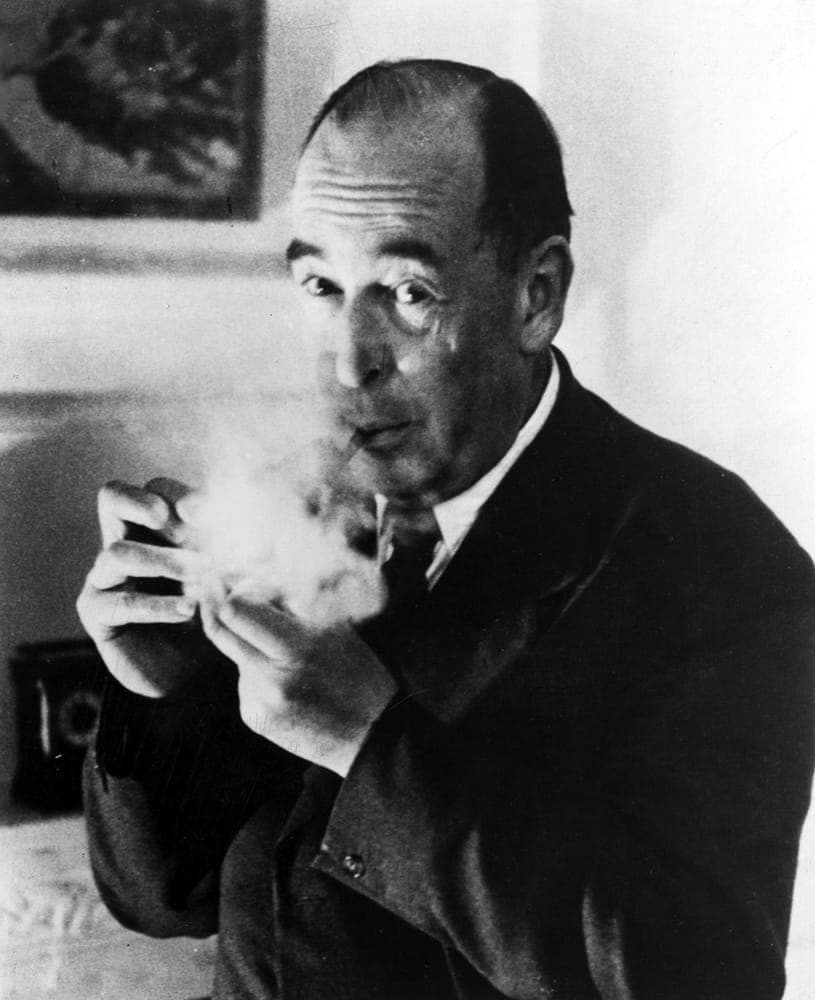
Born Clive Staples Lewis on November 29, 1898, in Belfast, the second son of a solicitor and a Church of Ireland clergyman's daughter who had been the first female mathematics graduate of Queen's College Belfast, he renamed himself Jacksie at four after the family dog was killed by a horse-drawn carriage, and was Jack to his friends for the rest of his life. His mother died of cancer when he was nine, and his father packed him off to a brutal English boarding school in Hertfordshire that he later called Belsen. He read classics at University College, Oxford, fought in the trenches at Arras and was wounded by friendly shellfire on Mount Bernenchon in April 1918, and returned to Oxford to a double first and a 1925 fellowship at Magdalen College, where he taught English for the next twenty-nine years. He became an atheist in adolescence and was argued back to Christianity around 1929 in part by his colleague J. R. R. Tolkien, with whom he founded the Inklings, a Thursday-evening reading group at the Eagle and Child. The Screwtape Letters (1942) made him famous; his BBC wartime broadcasts on Christianity were collected as Mere Christianity (1952). The seven Chronicles of Narnia, beginning with The Lion, the Witch and the Wardrobe (1950), have sold more than one hundred million copies. He moved to Magdalene College, Cambridge, in 1954, and in 1956 married the American writer Joy Davidman; she died of bone cancer four years later, and he wrote A Grief Observed (1961) under a pseudonym. He died on November 22, 1963, at his home the Kilns in Oxford, of renal failure, exactly a week before his sixty-fifth birthday and one hour before John F. Kennedy was shot in Dallas.
In September 1931, Lewis set out from Oxford in his brother's motorcycle sidecar bound for Whipsnade Zoo, not yet believing Jesus Christ was the Son of God. He did not experience the change as a sudden flash. When the sidecar reached the zoo gates, he found that he believed. He could never afterward say exactly when it had happened.
The first button needs the app on this device; the second gets it there.
In the canon, 18 works
- Out Of The Silent Planet1938
- The Screwtape Letters1942
- The Abolition of Man1943
- Perelandra1943
- That Hideous Strength1945
- On Stories1947
- The Chronicles of Narnia1950
- The Lion, The Witch and the Wardrobe1950
- Prince Caspian1951
- Mere Christianity1952
- The Voyage of the Dawn Treader1952
- The Silver Chair1953