
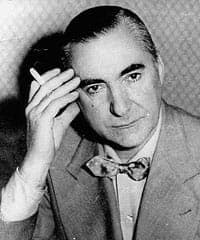
Author
Curzio Malaparte
- Lived
- Lived 1898 to 1957
- From
- From Italian
Born Kurt Erich Suckert on June 9, 1898, in Prato, Tuscany, to a German textile manager and his Lombard wife, he volunteered at sixteen for the Garibaldi Legion fighting for France in 1914, then crossed into the Italian army's Alpini regiments once Italy entered the war in 1915. Poison gas exposure on the front in 1918 left lung damage that never fully healed. In 1925 he adopted the surname Malaparte, a deliberate inversion of Bonaparte meaning the wrong side rather than the good one. He joined Mussolini's Fascist Party in 1922 and became one of its most visible young intellectuals through the 1920s, founding journals and editing newspapers, but his 1931 study Coup d'État: The Technique of Revolution included a chapter on Hitler sharp enough to get him expelled from the party in 1933. Mussolini's regime sent him into internal exile on the island of Lipari, then arrested him again and again through the war years, jailing him in Rome's Regina Coeli prison. Between spells in custody he built Casa Malaparte, a startling red house on a Capri cliff that later appeared in Jean-Luc Godard's Contempt. Dispatched to the Eastern Front in 1941 as a war correspondent for Corriere della Sera, he wrote Kaputt in secret, its pages reportedly smuggled to safety sewn into a peasant woman's clothing, and published it in Naples in 1944 while the war still raged. Its 1949 companion, The Skin, set amid the Allied occupation of Naples, was placed on the Vatican's Index of Forbidden Books. After the war his politics drifted left; he settled for a time in Paris, wrote for the stage, and directed the film Forbidden Christ, which won a prize at the 1951 Berlin festival. A late journey to Maoist China left him gravely ill. He died in Rome on July 19, 1957, of the lung cancer his wartime gassing had long threatened, received in his final weeks into the Catholic Church, a last contradiction from a man who had spent his life refusing to settle on one side.
The first button needs the app on this device; the second gets it there.
In the canon
- Kaputt1944
- The Skin1949