
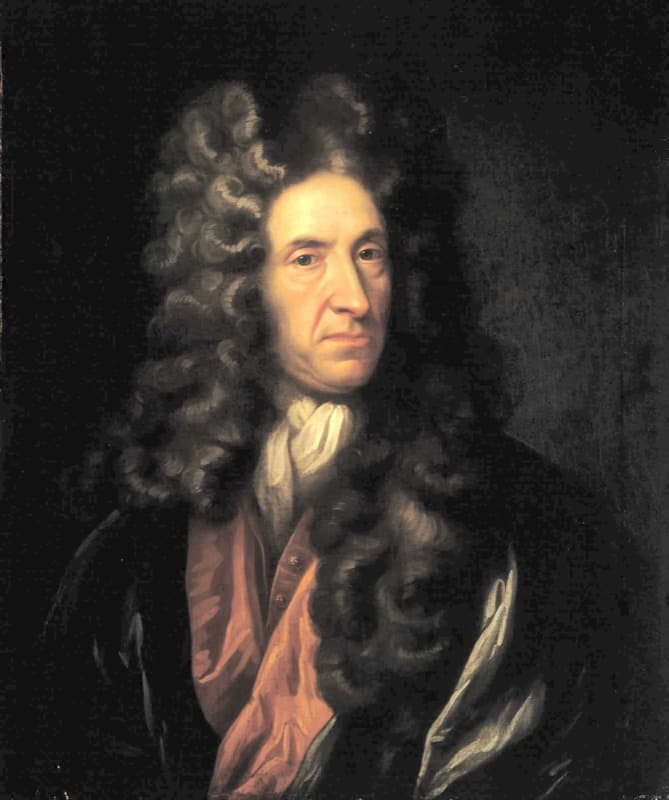
Author
Daniel Defoe
- Lived
- Lived 1660 to 1731
- From
- From English
- Born in
- Born in London, England
Born Daniel Foe around 1660 in the parish of St. Giles Cripplegate, London, the son of a tallow chandler, Defoe added the genteel "De" to his surname in his thirties. He was educated at a Dissenting academy in Newington Green, barred from Oxford and Cambridge by his family's Nonconformist faith. He tried his hand at the hosiery trade, dabbled in shipping and insurance, and went spectacularly bankrupt in 1692, owing the equivalent of millions. He became a political pamphleteer of extraordinary energy, writing for and against nearly every faction, which landed him in the pillory in 1703 for his satirical The Shortest-Way with the Dissenters (1702), a pamphlet so convincing in its mimicry of High Church bigotry that both sides were enraged. He served as a secret agent for Robert Harley, reporting on political sentiment across England and Scotland. Then, at nearly sixty, he invented the English novel. Robinson Crusoe (1719) became an instant sensation, followed by Moll Flanders (1722), A Journal of the Plague Year (1722), and Roxana (1724), each a masterpiece of first-person narration so vivid that readers took them for true accounts. He died on April 24, 1731, hiding from creditors in a lodging house in Ropemaker's Alley, Moorfields.
In 1722, fifty-seven years after the Great Plague of 1665, Defoe published A Journal of the Plague Year, an eyewitness account of grass growing in empty streets and death carts passing at night. He had been five years old when the plague struck, and built his narrator largely from his uncle Henry Foe's own recollections of the outbreak.
The first button needs the app on this device; the second gets it there.
In the canon
- The Storm1704
- Robinson Crusoe1719
- Captain Singleton1720
- Moll Flanders1722
- A Journal Of The Plague Year1722
- Roxana1724