
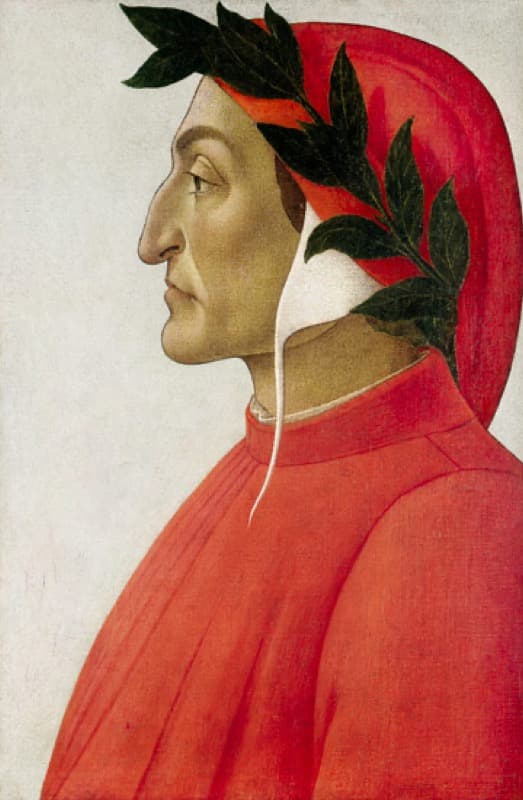
Author
Dante Alighieri
- Lived
- Lived 1265 to 1321
- From
- From Italian
- Born in
- Born in Florence, Italy
Born in 1265 in Florence to a family of minor nobility, Dante Alighieri was betrothed in childhood and married Gemma Donati, but the defining event of his inner life came at nine, when he first saw Beatrice Portinari. Her death in 1290 shattered him and inspired La Vita Nuova (1294), a sequence of poems and prose that transformed private grief into a new literary language. He threw himself into Florentine politics as a member of the White Guelphs and served as one of the city's six priors in 1300. Two years later, while on a diplomatic mission to Pope Boniface VIII in Rome, the Black Guelphs seized power with papal backing. Dante was condemned in absentia, fined, and sentenced to be burned alive if he ever returned. He never saw Florence again. For nearly twenty years he wandered from court to court across northern Italy, dependent on patrons in Verona, Ravenna, and Lunigiana, writing the work that would become the foundation of Italian literature. The Divine Comedy, composed in exile between roughly 1308 and 1320, mapped the entire medieval cosmos in 14,233 lines of terza rima, moving from the horrors of the Inferno through the penitential mountain of Purgatorio to the blazing light of Paradiso. He died in Ravenna on September 14, 1321, of malaria contracted on a diplomatic mission to Venice. Florence would spend centuries trying to reclaim his bones.
In 1315 Florence offered Dante a way home: pay a fine, walk in penitence to the Baptistery, and admit guilt. Thirteen years into exile, he refused. 'Can I not look upon the face of the sun and the stars everywhere?' he wrote to a friend. The sentence against him was renewed, and extended to his sons.
The first button needs the app on this device; the second gets it there.
In the canon
- The New Life1295
- La Vita Nuova1295
- Convivio1307
- The Divine Comedy1308
- The Inferno1308
- De Monarchia1313
- The Divine Comedy, Volume 3: Paradise1321