
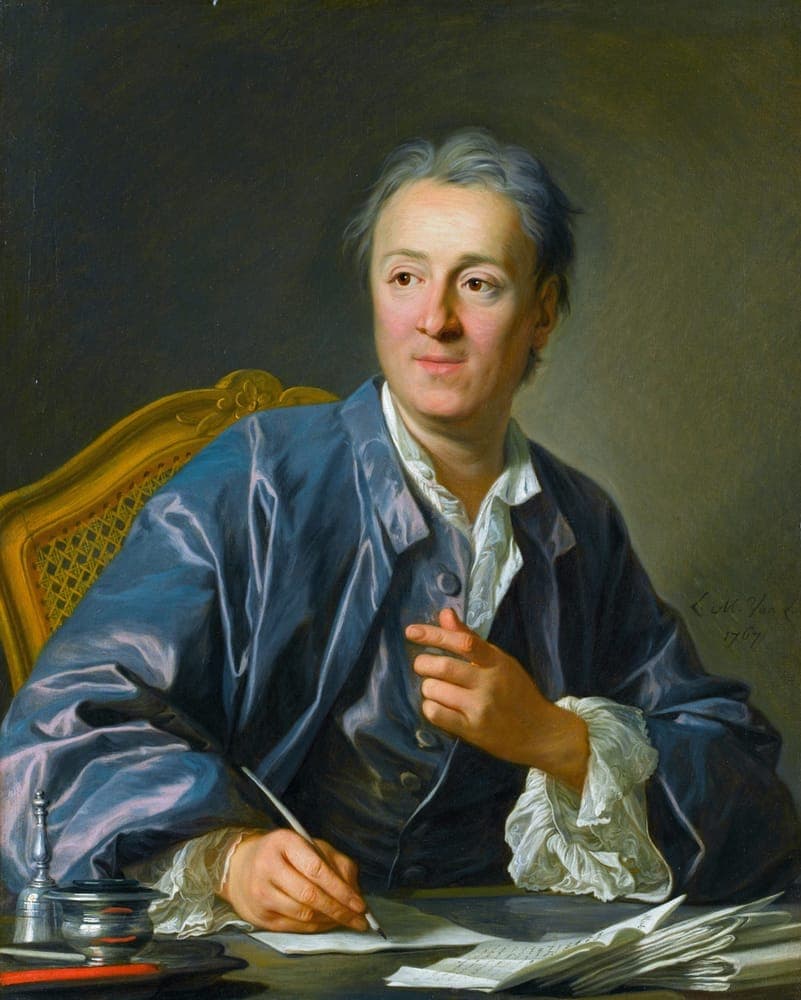
Author
Denis Diderot
- Lived
- Lived 1713 to 1784
- From
- From French
Born on October 5, 1713, in Langres in Champagne to Didier Diderot, a master cutler whose forge supplied the surgeons of eastern France, and Angélique Vigneron, Denis Diderot was the second of six children, three of whom survived. Educated at the Jesuit college in Langres, he was tonsured at thirteen with the prospect of inheriting his uncle's canonry. He took his Master of Arts at the University of Paris in 1732, considered law, then in 1734 announced that he meant to be a writer. His father disowned him. For the next decade he lived a bohemian existence in Paris, translating from English for booksellers, drinking coffee and arguing chess at the Café de la Régence, where he met Jean-Jacques Rousseau. In 1746 his first original book, the Pensées philosophiques, was condemned by the Paris parlement and burned. In 1751 he and Jean d'Alembert launched the Encyclopédie, the great project of the French Enlightenment, in twenty-eight volumes of articles and engraved plates that took twenty-five years to complete and that Diderot edited almost single-handedly after d'Alembert resigned in 1759. He wrote some seven thousand of its articles himself. The Catholic Church placed it on the Index in 1758; the French government banned it the next year, though the ban was not strictly enforced. Catherine the Great bought his library in 1766 to relieve his poverty and left it in his keeping, paying him as her librarian. His finest narrative fictions, Jacques the Fatalist, Rameau's Nephew, The Nun, and his philosophical dialogues, were circulated only in manuscript and published after his death. He died on July 31, 1784, in Paris at his rue de Richelieu apartment, of a gastrointestinal embolism, aged seventy.
The first button needs the app on this device; the second gets it there.
In the canon
- Encyclopédie1751
- Rameau's Nephew1761
- D'Alembert's Dream1769
- Jacques the Fatalist and His Master1796
- The Nun1796