
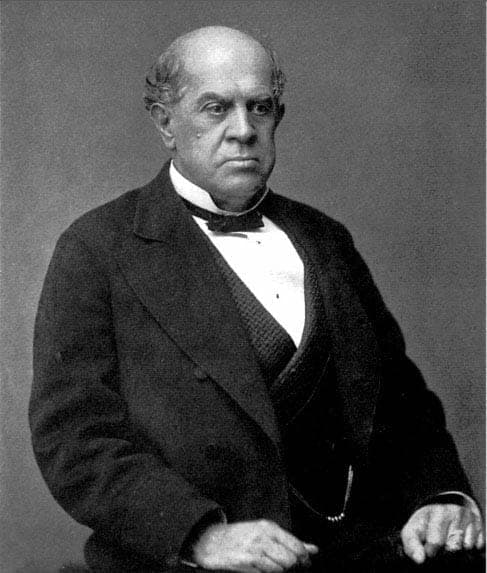
Author
Domingo Faustino Sarmiento
- Lived
- Lived 1811 to 1888
- From
- From Argentine
- Born in
- Born in San Juan, Argentina
Born on 15 February 1811 in El Carrascal, a poor quarter of San Juan in what was then the United Provinces of the Río de la Plata, Domingo Faustino Sarmiento was the son of a minor soldier of the wars of independence and a mother who wove ponchos to keep the family fed. He had almost no formal schooling, taught himself from whatever books passed through the frontier town, and was teaching elementary classes himself by his early teens. Opposition to the provincial strongman Facundo Quiroga and later to the dictator Juan Manuel de Rosas sent him into exile in Chile in 1831 and again in 1840, after a brief return to San Juan to found the newspaper El Zonda. In Chile he became a journalist and educator, directing South America's first teacher-training school and editing the paper El Progreso, where in 1845 he serialized Facundo, a biography of the dead caudillo Quiroga that doubled as an indictment of Rosas and introduced the phrase civilization and barbarism into the continent's political vocabulary. Between 1845 and 1847 he toured Europe, North Africa, and the United States studying school systems, and in Boston formed a lasting friendship with the educators Horace Mann and Mary Peabody Mann, whose common-school ideas he carried home. After Rosas fell in 1852 he returned to Argentina, served as governor of San Juan, and was Argentina's minister to Washington from 1865 to 1868, writing a biography of Abraham Lincoln after the assassination. Elected president in 1868, he founded some eight hundred schools, imported dozens of North American teachers, laid thousands of kilometers of telegraph line, and took the country's first national census, all while grieving his adopted son Dominguito, killed in the Paraguayan War, and surviving a bomb attack in 1873 that he never even heard, already deaf by then. He died of a heart attack in Asunción, Paraguay, on 11 September 1888, at seventy-seven, a date Argentina still keeps as its Teacher's Day.
As a boy in San Juan, Sarmiento read the Life of Franklin and said later that no book had done him more good. I felt myself to be Franklin, he wrote: as poor as him, as studious, certain that by following his path he too could become a man of letters and of American politics.
Siento que el frío del bronce me invade los pies.
The first button needs the app on this device; the second gets it there.
In the canon
- Facundo1845