
Author
Eça de Queirós
- Lived
- Lived 1845 to 1900
- From
- From Portuguese
- Born in
- Born in Póvoa de Varzim, Portugal
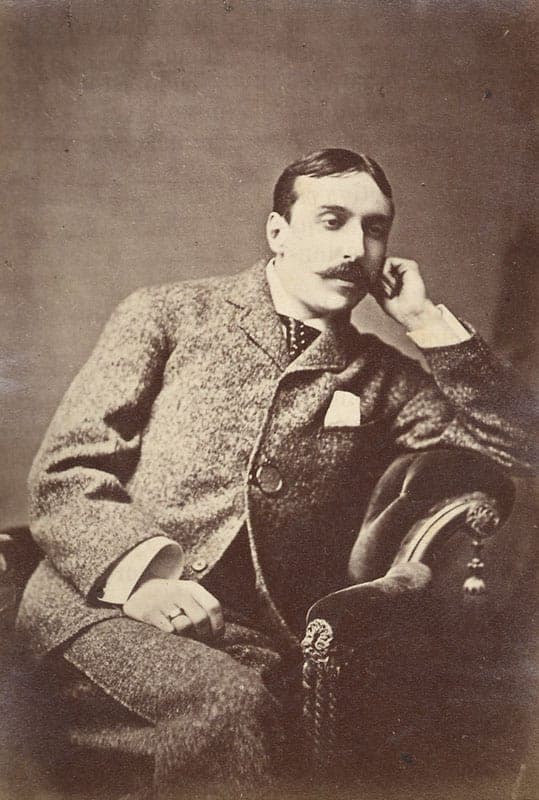
Born José Maria de Eça de Queirós on 25 November 1845 in Póvoa de Varzim, on Portugal's northern Atlantic coast, he was the son of a magistrate and a mother not yet married to him; the parish register recorded the birth as the child of an unknown woman, and he was raised by his grandparents until his parents wed four years later. He read law at Coimbra, where he formed a lifelong friendship with the poet Antero de Quental, and in 1871 delivered a lecture on literary realism at Lisbon's Casino conferences, a short series of public talks on new European ideas that the government banned within weeks. He entered the diplomatic service in 1872, serving as consul in Havana and then, from 1874, in Newcastle upon Tyne, where English life became both an irritant and, by his own admission, a corrective to his native Francophilia. His first novel, O Crime do Padre Amaro, appeared in serial form in 1875 and then, entirely rewritten, in book editions of 1876 and 1880, a scalding satire of clerical hypocrisy shaped by his reading of Flaubert and Balzac. O Primo Basílio followed in 1878. Posted to Bristol in 1879, he married Maria Emília de Castro in 1886 and, dividing his weeks with a second household in London, completed Os Maias in 1888, his sweeping account of a wealthy Lisbon family's decline across three generations. That year he became consul general in Paris, settling at Neuilly-sur-Seine and continuing to write journalism, the invented correspondence of his alter ego Fradique Mendes, and further novels including The Relic (1887). He died at his Paris home on 16 August 1900, at fifty-four, his doctors unable to agree whether tuberculosis or a chronic intestinal illness had killed him, and was given a state funeral on his body's return to Lisbon that September. In January 2025, one hundred and twenty-five years later, his remains were moved a final time into the National Pantheon.
In 1875 Eça sent proofs of his first novel to friends running a literary magazine, only for them to serialize the story before he could revise a line. Appalled by what appeared, he spent the next five years rewriting it twice more, until the finished Crime of Father Amaro ran five times the length of that hasty first printing.
The first button needs the app on this device; the second gets it there.
In the canon
- The Crime of Father Amaro1875
- The Maias1888