
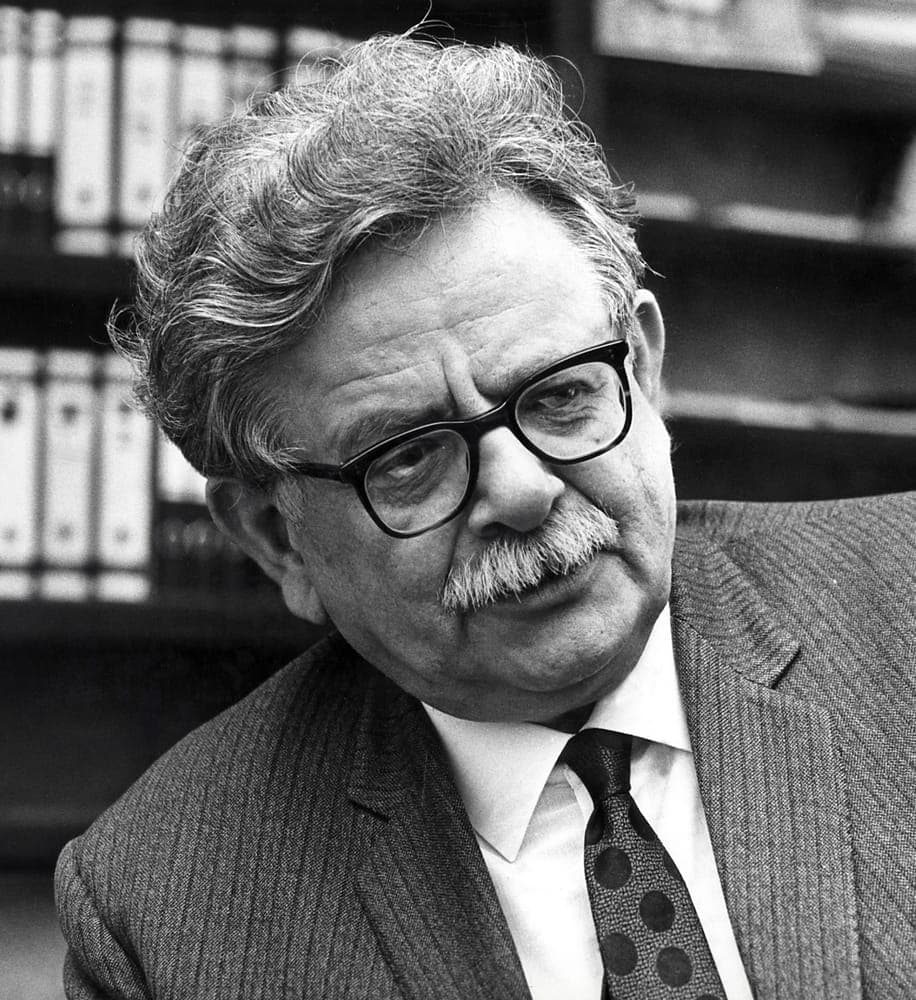
Author
Elias Canetti
- Lived
- Lived 1905 to 1994
- From
- From Bulgarian-Austrian
- Born in
- Born in Ruse, Bulgaria
Born on July 25, 1905, in Ruse, a Danube port in Bulgaria, into a Sephardic Jewish family whose ancestors had carried the name Cañete from a village in Spain through Adrianople and Livorno, Elias Canetti spent his first six years speaking Ladino, Bulgarian, and English. His father, a merchant, died suddenly in 1912 when the family had just settled in Manchester. His mother insisted the boy learn German, drilling him so harshly that he later said she gave him his second mother tongue under duress, and a love for the language that never left him. Vienna shaped him; he took a doctorate in chemistry in 1929 but never practised, drawn instead to the literary cafés and to the burning of the Palace of Justice in 1927, an image of mob violence he would worry at for the rest of his life. Auto-da-Fé (1935), the only novel he ever wrote, follows a reclusive Sinologist whose library of twenty-five thousand books is consumed by fire. After the Anschluss he fled to London, where he worked for decades on Crowds and Power (1960), a long study of the psychology of masses and rulers. Late in life he returned to the Ladino-inflected world of his childhood in the autobiographical trilogy that began with The Tongue Set Free (1977). He won the Nobel Prize in Literature in 1981, cited for the broad outlook and artistic power of his German prose. John Bayley, husband of his sometime lover Iris Murdoch, called him the monster of Hampstead. He died in Zurich on August 14, 1994, at the age of eighty-nine.
On 15 July 1927 Canetti, a twenty-one-year-old chemistry student, was in the Vienna streets as the Palace of Justice burned and the police fired into the crowd, killing nearly ninety people. In the smoke he noticed one man crying out that the files were burning, all the files. That man, mourning paper over the dead, became Peter Kien.
The first button needs the app on this device; the second gets it there.
In the canon
- Auto Da Fé1935
- Crowds And Power1960
- The Voices of Marrakesh1968
- Kafka's Other Trial1969
- The Tongue Set Free1977