
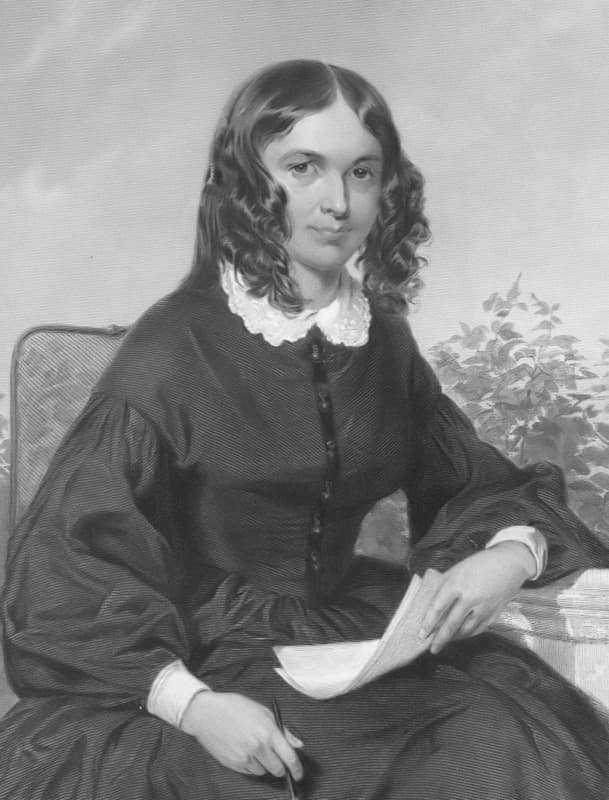
Author
Elizabeth Barrett Browning
- Lived
- Lived 1806 to 1861
- From
- From English
- Born in
- Born in Coxhoe Hall, County Durham, England
Born on March 6, 1806, at Coxhoe Hall in County Durham, England, Elizabeth Barrett was the eldest of twelve children in a wealthy family whose fortune derived from Jamaican sugar plantations. She was reading Homer in Greek by the age of ten and composed her first epic poem, The Battle of Marathon, at twelve, which her father had privately printed. A spinal injury at fifteen and a chronic lung ailment that followed confined her increasingly to sickrooms and made her dependent on morphine for the rest of her life. Her brother Edward drowned in a sailing accident at Torquay in 1840 while keeping her company during a convalescence, and the guilt haunted her for decades. She retreated to her father’s house at 50 Wimpole Street, London, where she lived as a near-invalid under his despotic authority, he had forbidden any of his children to marry. Her Poems (1844) made her the most celebrated female poet in England and drew an admiring letter from the younger poet Robert Browning: “I love your verses with all my heart, dear Miss Barrett.” Their courtship unfolded in 574 letters over twenty months, conducted in secret for fear of her father’s rage. They married on September 12, 1846, at St Marylebone Parish Church with only two witnesses, and eloped to Italy a week later. Her father disinherited her and never spoke to her again. In Florence she wrote Sonnets from the Portuguese (1850), a sequence of forty-four love sonnets addressed to Robert that contains the line “How do I love thee? Let me count the ways.” Aurora Leigh (1856), a verse novel about a woman poet’s struggle for independence, was a bestseller and an early feminist landmark. She died in Robert’s arms in Florence on June 29, 1861.
Days before her secret wedding in 1846, her cocker spaniel Flush was stolen for the third time by a London dognapping gang. Rather than pay through an intermediary, she went herself into Whitechapel to negotiate with its ringleader, Taylor, and bought Flush back for six pounds and six guineas.
Beautiful.
The first button needs the app on this device; the second gets it there.
In the canon
- Sonnets from the Portuguese1850
- How do I love thee? Let me count the ways (Sonnet 43)1850
- If thou must love me, let it be for nought (Sonnet 14)1850
- I thought once how Theocritus had sung (Sonnet 1)1850
- Say over again, and yet once over again (Sonnet 21)1850
- Go from me. Yet I feel that I shall stand (Sonnet 6)1850
- Casa Guidi Windows1851
- Aurora Leigh1856
- A Curse for a Nation1860