
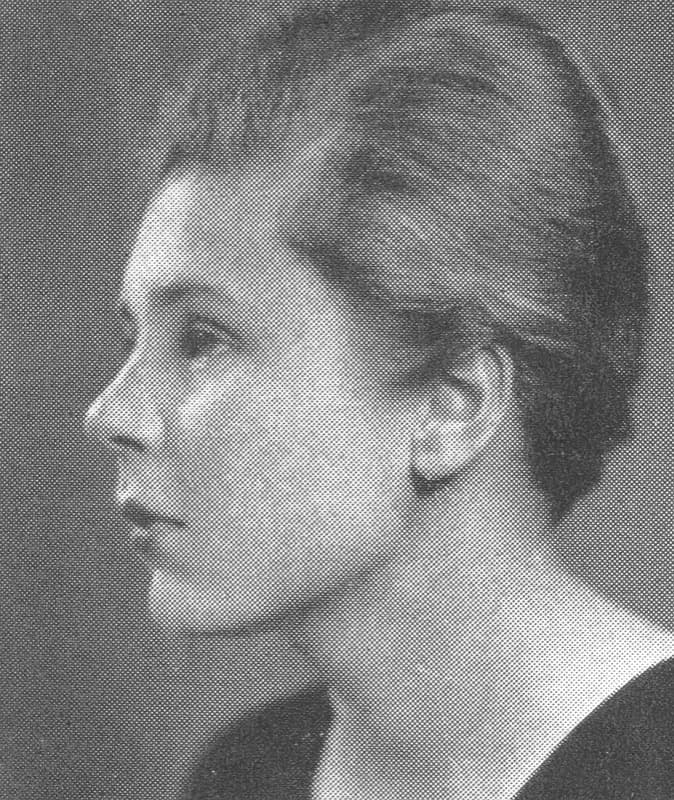
Author
Elizabeth Bishop
- Lived
- Lived 1911 to 1979
- From
- From American
- Born in
- Born in Worcester, Massachusetts
Born on February 8, 1911, in Worcester, Massachusetts, Elizabeth Bishop lost her father to Bright’s disease when she was eight months old. Her mother, shattered by grief, suffered a series of mental breakdowns and was permanently committed to an institution in 1916; Bishop never saw her again. Raised first by her maternal grandparents in Nova Scotia, a period of warmth she returned to throughout her poetry, she was then claimed by her father’s wealthier family in Worcester, where she was miserable and developed the chronic asthma that plagued her for life. She attended Vassar College, where she co-founded a literary magazine and met the poet Marianne Moore, who became a lifelong mentor. Her first collection, North & South (1946), appeared after years of painstaking revision; she published only four slim volumes in her lifetime, an output reflecting her extraordinary fastidiousness. In 1951 she traveled to Brazil on a freighter, suffered a violent allergic reaction to a cashew fruit upon arrival, and stayed for nearly seventeen years, living with the architect and political figure Lota de Macedo Soares. A Cold Spring (1955) won the Pulitzer Prize. Questions of Travel (1965) drew on her Brazilian years. After Soares’s suicide in 1967, Bishop returned to the United States and taught at Harvard. Geography III (1976), her final collection, contains “One Art,” a villanelle on loss whose controlled devastation ranks it among the finest poems of the twentieth century. She won the Neustadt International Prize for Literature in 1976. She died of a cerebral aneurysm in her Boston apartment on October 6, 1979, at the age of sixty-eight.
In the summer of 1948, on a rock above the Maine coast, Bishop told Robert Lowell, 'When you write my epitaph, you must say I am the loneliest person that ever lived.' Lowell later confessed he decided that day he wanted to marry her, though he never asked, calling it 'the might have been for me.'
The first button needs the app on this device; the second gets it there.
In the canon, 21 works
- The Map1946
- The Man-Moth1946
- The Fish1946
- A Miracle for Breakfast1946
- Roosters1946
- Casabianca1946
- The Imaginary Iceberg1946
- Love Lies Sleeping1946
- At the Fishhouses1947
- Arrival at Santos1965
- The Armadillo1965
- Sestina1965