
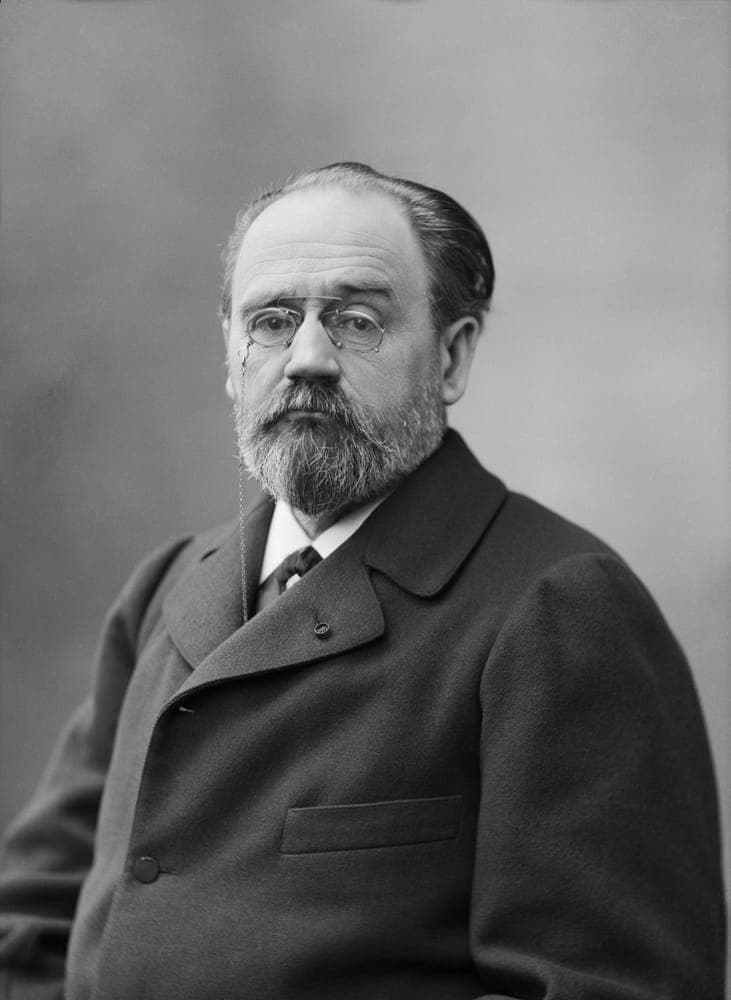
Author
Émile Zola
- Lived
- Lived 1840 to 1902
- From
- From French
- Born in
- Born in Paris, France
Born Émile Édouard Charles Antoine Zola on April 2, 1840, in Paris to a Venetian-born engineer who designed the Zola Dam at Aix-en-Provence and a French mother, he lost his father at seven and was raised on a meagre pension in Provence, where he formed a lifelong friendship with the young Paul Cézanne. Returning to Paris, he failed his baccalauréat twice, worked as a clerk in a shipping firm, and joined the publisher Hachette, where he wrote literary and political journalism that did not hide his contempt for Napoleon III. Hachette dismissed him after the sordid autobiographical novel La Confession de Claude (1865) drew police attention. Thérèse Raquin (1867), a grim study of adultery and remorse, announced naturalism in the French novel. From 1871 he gave himself to Les Rougon-Macquart, a twenty-volume natural and social history of a family under the Second Empire, traced from peasant Plassans into mine, market, brothel, and battlefield. L'Assommoir (1877) made him wealthy. Nana (1880), Germinal (1885), and La Bête humaine (1890) followed. He wrote every day for thirty years under the motto nulla dies sine linea, no day without a line. On January 13, 1898, he published J'accuse on the front page of L'Aurore, his open letter to the President of the Republic exposing the army's frame-up of the Jewish officer Alfred Dreyfus. He was convicted of libel and fled to a year in England. He died at home in Paris on the night of September 28, 1902, asphyxiated by a blocked chimney, aged sixty-two. The roofer responsible, decades later, confessed to a friend that he had done it for the army.
On January 13, 1898, Zola's letter accusing the army of framing Alfred Dreyfus ran under the headline J'accuse, chosen by his editor Georges Clemenceau; three hundred thousand copies sold out that morning. Convicted of libel, Zola fled to England that July with almost nothing, just a nightshirt wrapped in newspaper for the crossing.
The first button needs the app on this device; the second gets it there.
In the canon, 13 works
- Thérèse Raquin1867
- Les Rougon Macquart1871
- The Belly of Paris1873
- L'Assommoir1877
- Drunkard1877
- Nana1880
- Au Bonheur Des Dames1883
- Germinal1885
- The Beast Within1890
- La Bête humaine1890
- L'argent1891
- La Débâcle1892