
Author
Emily Dickinson
- Lived
- Lived 1830 to 1886
- From
- From American
- Born in
- Born in Amherst, Massachusetts
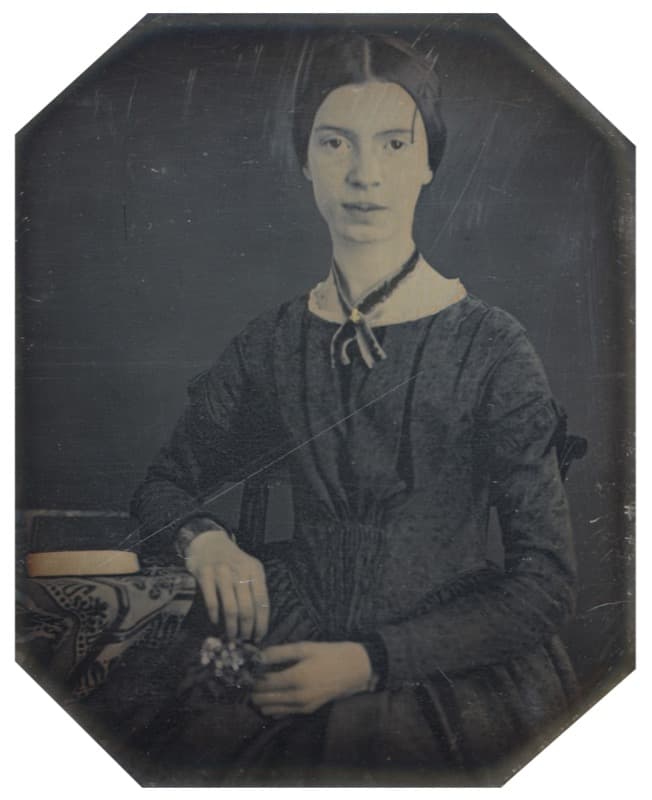
Born on December 10, 1830, in Amherst, Massachusetts, Emily Elizabeth Dickinson grew up in a prominent New England family, her grandfather Samuel Dickinson had founded Amherst College, and her father Edward served as its treasurer and as a United States congressman. She attended Amherst Academy for seven years and spent one year at Mount Holyoke Female Seminary before returning home, apparently unwilling to make the public declaration of faith the school required. From her early thirties onward she increasingly withdrew from society, rarely leaving the family homestead and eventually communicating with most visitors only through a closed door. She dressed exclusively in white and became, to the townspeople of Amherst, an enigmatic recluse. Behind that door she was prolific beyond anyone’s knowledge. She composed approximately 1,800 poems, hand-stitching many of them into small booklets called fascicles, using dashes, slant rhyme, unconventional capitalization, and compressed metaphor in ways that anticipated modernist poetry by half a century. Only ten of her poems appeared in print during her lifetime, most of them altered by editors to fit conventional taste. Her subjects ranged across death, immortality, nature, and ecstasy with an intensity that could concentrate the cosmos into a quatrain. After her death on May 15, 1886, from Bright’s disease, her sister Lavinia discovered the cache of nearly eighteen hundred poems in a locked chest. The first posthumous volume appeared in 1890 and went through eleven editions in two years. With Walt Whitman, she is now recognized as one of the two foundational poets of American literature, though the two never met, never read each other, and could hardly have been more different in temperament or method.
Dressed in white, Dickinson met most of her visitors only through a half-open door, and for the last two decades rarely left the family house in Amherst. Behind that door she wrote with volcanic intensity, stitching her poems by hand into small booklets that almost no one saw.
I must go in, the fog is rising.
The first button needs the app on this device; the second gets it there.
In the canon, 27 works
- These are the days when Birds come back1859
- Safe in their Alabaster Chambers1859
- I felt a Funeral, in my Brain1861
- I taste a liquor never brewed1861
- A Bird, came down the Walk1862
- The Brain is wider than the Sky1862
- I dwell in Possibility1862
- Because I could not stop for Death1863
- I cannot live with You1863
- Success is counted sweetest1864
- A Light exists in Spring1864
- I never saw a Moor1865