
Author
Emine Sevgi Özdamar
- Lived
- Lived born 1946
- From
- From Turkish-German
- Born in
- Born in Malatya, Turkey
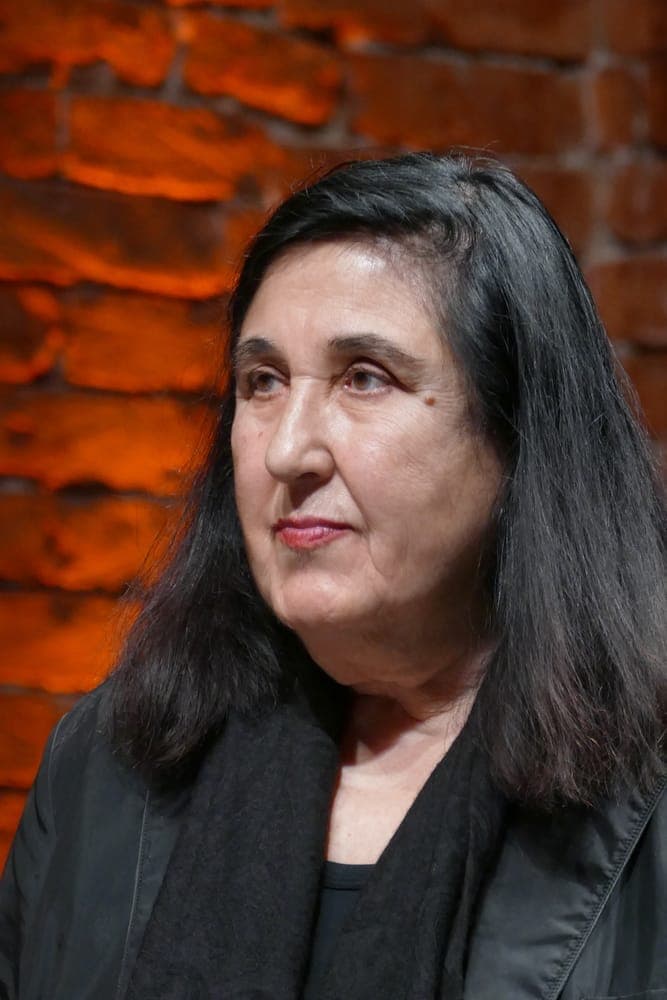
Born Emine Sevgi Özdamar on August 10, 1946, in Malatya, Turkey, she was raised largely by her grandparents while her family moved between Istanbul and Bursa chasing her father's work, and she began acting in plays at twelve. In 1965 she traveled to West Berlin to be near her older brother, taking a factory job and learning German from street signs and newspaper headlines before she could read it in books. She returned to Istanbul in 1967 to study under the leftist director Vasıf Öngören, taking roles in Peter Weiss's Marat/Sade and Brecht's Mann ist Mann, until the 1971 military coup ended her theatre and union work. Back in Germany in 1976, she became Benno Besson's assistant director at the Volksbühne in East Berlin while living across the border in the West, crossing daily between the two Berlins during the years she worked alongside Brecht's theatrical heirs Matthias Langhoff and Heiner Müller. She later assisted at Claus Peymann's Bochumer Ensemble and, cast repeatedly as an immigrant mother or housewife in West German film and television, earned the wry nickname Mutter aller Filmtürken, mother of all Turks on film. Her 1990 debut story collection, Mutterzunge, was named International Book of the Year by the Times Literary Supplement, and in 1991 she became the first author of Turkish origin to win the Ingeborg Bachmann Prize, for chapters of the novel that appeared the next year as Life Is a Caravanserai Has Two Doors I Went in One I Came out the Other. She married the stage designer Karl Kneidl in 1986. Further novels followed, The Bridge of the Golden Horn (1998), Strange Stars Stare at the Earth (2003), and A Space Bounded by Shadows (2021), building a body of work written in a German seeded through with Turkish idiom, proverb, and translated metaphor. She has won the Adelbert von Chamisso Prize, the Kleist Prize, and, in 2022, the Georg Büchner Prize, Germany's highest literary honor. She lives in Berlin.
In 1976, back in Berlin, she became director's assistant to Benno Besson at the Volksbühne on Rosa-Luxemburg-Platz, in the East, working alongside Brecht's own theatrical heirs. She lived across the border, in the West, and crossed the checkpoint on foot every morning, then walked back through the Wall each night.
The first button needs the app on this device; the second gets it there.
In the canon
- Life is a Carawanserai Has Two Doors I Went in One I Came out the Other1992