
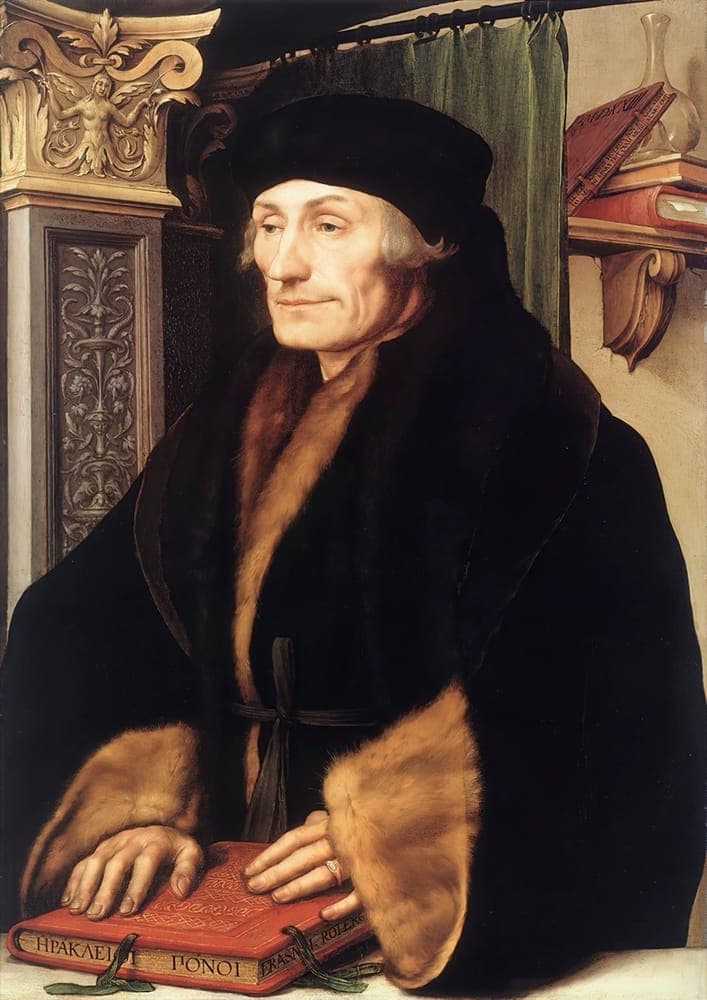
Author
Erasmus
- Lived
- Lived 1466 to 1536
- From
- From Dutch
- Born in
- Born in Rotterdam, Netherlands
Born around October 28, 1466, in Rotterdam, in the county of Holland, Desiderius Erasmus was the illegitimate son of a priest named Gerard and a physician's daughter named Margaret, a circumstance that shadowed him and which he obscured in his own accounts. Orphaned by plague in his teens, he was placed in a monastery school and pressured into the Augustinian canons at Steyn, taking vows around 1488. He chafed against monastic life and secured a dispensation, drifting toward Paris, then to England, where he met Thomas More and John Colet, friendships that shaped him. He learned Greek late and with ferocity, becoming the foremost classical scholar of his age. The Praise of Folly (1511), written in a week at More's house and punning on his friend's name in its Greek title, let the goddess Folly deliver a mocking oration that turned its satire on monks, theologians, and popes. His Adagia (1500), an ever-expanding collection of classical proverbs, made him famous across Europe, and his Greek New Testament (1516), printed alongside a fresh Latin translation, reshaped biblical scholarship and lit fuses he never meant to. He quarreled with Luther over free will in On Free Will (1524), refusing to follow the Reformation he had helped provoke, and was claimed by neither side. He wrote constantly, corresponded with kings and humanists across the continent, and never held a settled post, moving between Louvain, Basel, and Freiburg. He died on July 12, 1536, in Basel, around the age of sixty-nine, reportedly murmuring in his native Dutch rather than the Latin he had served all his life.
Not long after Pope Julius II died in 1513, a merciless Latin dialogue began circulating in which the dead warrior pope demands entry to heaven and Saint Peter turns him away. Educated Europe suspected Erasmus at once. He denied writing it for the rest of his life, even to friends who already knew otherwise.
Lieve God (Dear God).
The first button needs the app on this device; the second gets it there.
In the canon
- The Praise of Folly1511