
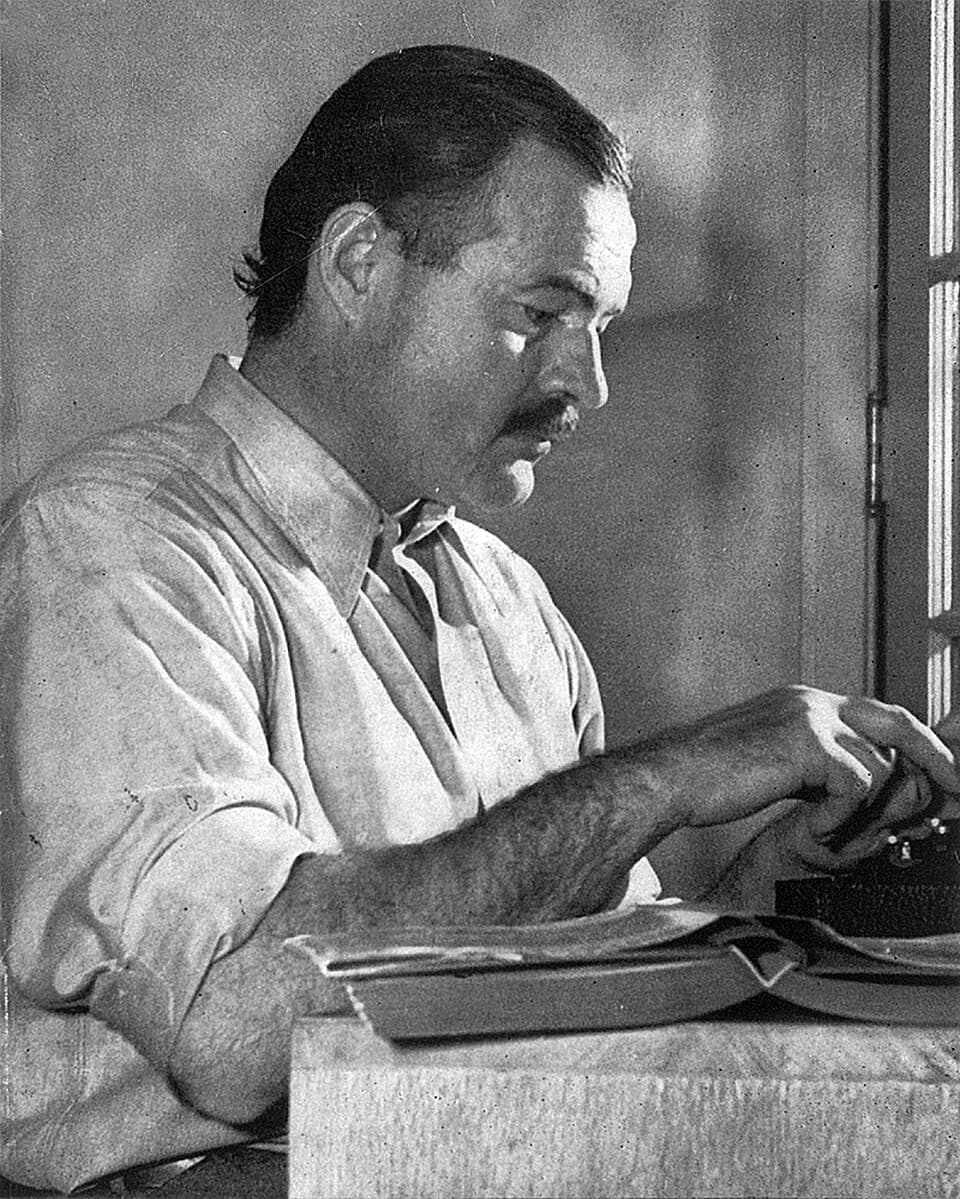
Author
Ernest Hemingway
- Lived
- Lived 1899 to 1961
- From
- From American
- Born in
- Born in Oak Park, Illinois
Born in Oak Park, Illinois, in 1899, Hemingway rejected college to become a reporter at the Kansas City Star, where he learned the economy of expression that would define his fiction. At eighteen he volunteered as an ambulance driver on the Italian front in World War I and was severely wounded by mortar fire, an experience that haunted everything he wrote. He joined the expatriate literary scene in 1920s Paris, where Gertrude Stein and Ezra Pound helped shape his style, and published The Sun Also Rises (1926) and A Farewell to Arms (1929), establishing his reputation as the voice of the Lost Generation. He covered the Spanish Civil War as a correspondent, hunted German U-boats in the Caribbean during World War II, and survived two plane crashes on safari in Africa. He married four times, lived in Key West, Cuba, and Ketchum, Idaho, and won the Nobel Prize in Literature in 1954. His later years were marked by alcoholism, depression, paranoia, and electroshock treatments that erased his memory. He took his own life with a shotgun on July 2, 1961, at his home in Idaho.
In July 1918, an Austrian mortar shell exploded in a trench at Fossalta di Piave, driving 227 fragments into Hemingway's legs. Badly wounded, he carried a fellow soldier to safety and earned Italy's Silver Medal of Military Valor. He was eighteen. The nurse who tended him in Milan became Catherine Barkley in A Farewell to Arms.
The first button needs the app on this device; the second gets it there.
In the canon, 38 works
- Up in Michigan1923
- Indian Camp1925
- The Doctor and the Doctor's Wife1925
- The End of Something1925
- The Three-Day Blow1925
- The Battler1925
- A Very Short Story1925
- Soldier's Home1925
- The Revolutionist1925
- Mr. and Mrs. Elliot1925
- Cat in the Rain1925
- Out of Season1925