
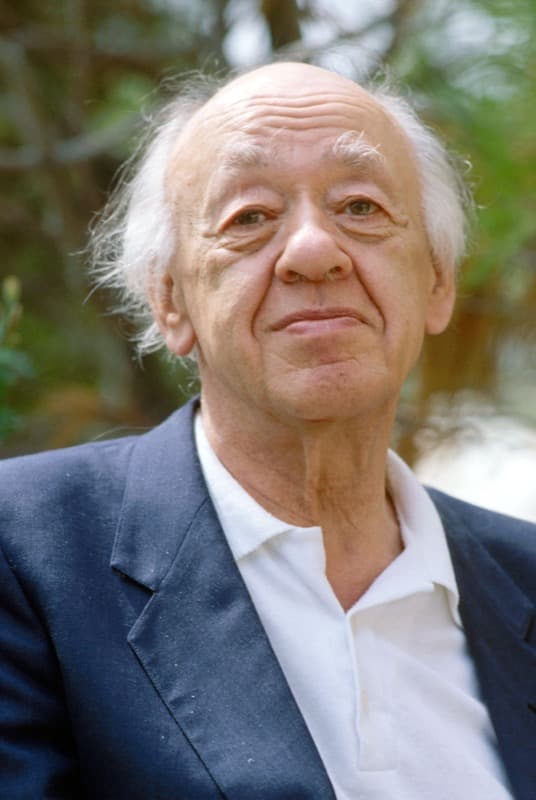
Author
Eugène Ionesco
- Lived
- Lived 1909 to 1994
- From
- From Romanian-French
- Born in
- Born in Slatina, Romania
Born on November 26, 1909, in Slatina, Romania, to a Romanian father and a French mother, Eugène Ionesco was taken to Paris as an infant and spent his early childhood in France before returning to Romania in 1925. He earned a degree in French literature at the University of Bucharest, married Rodica Burileanu in 1936, and won a government fellowship to study in Paris in 1938, where, after the outbreak of war and the descent of Romania into fascism, he made his permanent home. While working as a proofreader in the late 1940s, he decided to learn English using an Assimil phrase book; the stilted, absurd platitudes of its dialogue exercises, “The ceiling is up, the floor is down”, struck him as a revelation about the emptiness of everyday language. The result was La Cantatrice chauve (The Bald Soprano, 1950), an “anti-play” in which a bourgeois English couple exchange meaningless courtesies that spiral into verbal chaos. It bewildered its first audiences but became one of the founding works of what the critic Martin Esslin would call the Theatre of the Absurd. La Leçon (The Lesson, 1951) and Les Chaises (The Chairs, 1952) followed in rapid succession. Rhinocéros (1959), in which the inhabitants of a small town transform one by one into rhinoceroses, was his most popular and most overtly political work, a parable of conformity and totalitarianism rooted in his memories of watching friends and colleagues embrace fascism in 1930s Bucharest. He was elected to the Académie française in 1970, an extraordinary honor for a Romanian-born writer who had reinvented the French stage by dismantling its conventions. He died in Paris on March 28, 1994, at the age of eighty-four.
Learning English from a phrasebook in the late 1940s, Ionesco was working as a proofreader when its flat exercises, the ceiling is above, the floor is below, struck him as revelations of the absurd. Language itself seemed to come loose from meaning. Out of those dead sentences he wrote The Bald Soprano, and a new kind of theatre began.
The first button needs the app on this device; the second gets it there.
In the canon
- The Bald Soprano1950
- The Lesson1951
- The Chairs1952
- The Killer1958
- Rhinoceros1959
- Rhinoceros and Other Plays1959
- Exit the King1962