
Author
Euripides
- Lived
- Lived 480 BCE to 406 BCE
- From
- From Ancient Greek
- Born in
- Born in Salamis, Greece
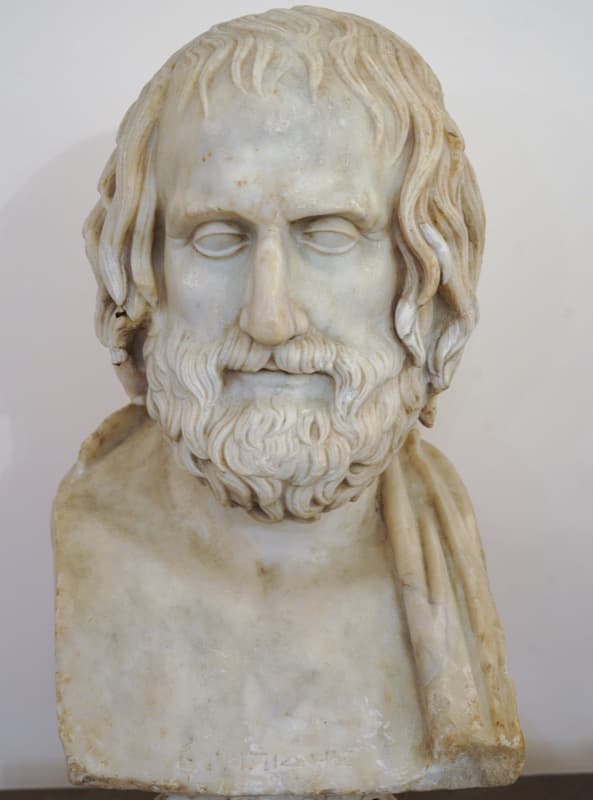
Born around 480 BCE on the island of Salamis, according to tradition, on the very day of the great naval battle that broke the Persian fleet, Euripides grew up in an Athens at the height of its cultural power. His family was likely prosperous, despite later comic poets’ jokes about his mother selling vegetables. He was the youngest of the three great Athenian tragedians, a generation behind Aeschylus and roughly contemporary with Sophocles, and yet he won first prize at the Dionysia only five times in a career spanning nearly fifty years, a record that suggests how deeply his innovations disturbed his audiences. Where Aeschylus staged the grandeur of cosmic justice and Sophocles the dignity of human suffering, Euripides brought the gods down to earth and exposed them as petty, cruel, or indifferent. His characters, Medea in her rage, Phaedra in her shame, Hecuba in her grief, are psychologically modern in a way that startled fifth-century Athens. Medea (431 BCE), in which a betrayed wife murders her own children, placed the inner life of a barbarian woman at the center of the Athenian stage and won only third prize. The Trojan Women (415 BCE) depicted the aftermath of conquest with such devastating clarity that audiences read it as a commentary on Athens’s own brutal destruction of Melos. He wrote perhaps ninety plays; nineteen survive, far more than those of Aeschylus or Sophocles combined, preserved partly because later schoolmasters found his clear, colloquial Greek ideal for teaching. Near the end of his life he left Athens for the court of King Archelaus in Macedonia, where he wrote The Bacchae, a terrifying play about the god Dionysus and the cost of denying elemental forces. He died in Macedonia in the winter of 406 BCE, and The Bacchae was performed posthumously in Athens, where it won first prize.
Tradition holds that Euripides retreated to a ten-chambered cave above the sea on Salamis, stocked with his library, to write in solitude, away from society he was said to shun. In 1994 archaeologists excavating the cave found a pot inscribed with the first letters of his name, evidence the legend had a real address.
The first button needs the app on this device; the second gets it there.
In the canon, 15 works
- Alcestis438 BCE
- Medea431 BCE
- Hippolytus428 BCE
- Andromache425 BCE
- Hecuba424 BCE
- Heracles416 BCE
- Trojan Women415 BCE
- Iphigenia in Tauris414 BCE
- Ion413 BCE
- Electra413 BCE
- Helen412 BCE
- Orestes408 BCE