
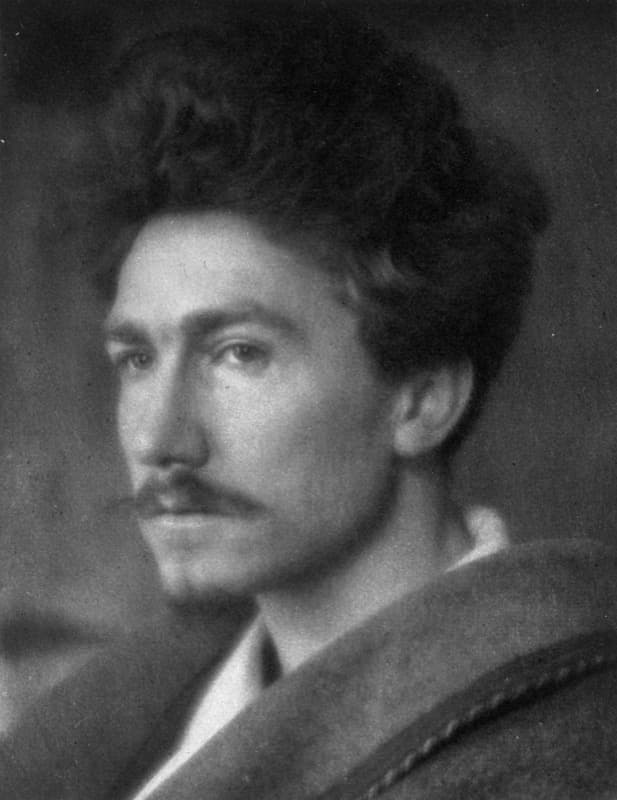
Author
Ezra Pound
- Lived
- Lived 1885 to 1972
- From
- From American
- Born in
- Born in Hailey, Idaho
Born on October 30, 1885, in Hailey, Idaho Territory, Ezra Weston Loomis Pound grew up near Philadelphia, where his father worked at the United States Mint. He studied at the University of Pennsylvania, where he befriended William Carlos Williams and H.D. (Hilda Doolittle), and earned a degree from Hamilton College before briefly teaching Romance languages at Wabash College in Indiana, from which he was dismissed after a scandal involving a stranded actress found in his room. In 1908 he sailed for Europe with sixty copies of his self-published first book, A Lume Spento, and settled in London, where he became the most consequential literary impresario of the twentieth century. He championed and edited the early work of T. S. Eliot, James Joyce, Robert Frost, Ernest Hemingway, and Marianne Moore, founded the Imagist movement, and served as foreign editor of Poetry and The Little Review. Hugh Selwyn Mauberley (1920) was his farewell to London; he moved to Paris, then to Rapallo, Italy, where he devoted himself to The Cantos, an epic poem of over eight hundred pages that he composed and revised for more than fifty years. During World War II he made hundreds of radio broadcasts for Mussolini’s fascist government, denouncing the Allies and spouting antisemitic conspiracy theories. Arrested by American forces in 1945, he was held in an open-air cage at a military detention center near Pisa before being declared mentally unfit to stand trial for treason and confined to St. Elizabeths Hospital in Washington, D.C., for twelve years. While there, he received the Bollingen Prize for The Pisan Cantos (1948), a decision that ignited a furious national debate about art and morality. Released in 1958 after appeals from Frost, Hemingway, and others, he returned to Italy and spent his final years in Venice in near-total silence. He died on November 1, 1972, at the age of eighty-seven.
In 1922 T. S. Eliot handed Pound the sprawling manuscript of The Waste Land. Pound slashed it nearly in half, striking whole passages with the margin note 'make up yr mind,' and handed back the poem that would define modern verse. Eliot dedicated it to him: il miglior fabbro, the better craftsman.
The first button needs the app on this device; the second gets it there.
In the canon
- Personae1909
- The Seafarer1912
- Hugh Selwyn Mauberley1920
- The ABC of Reading1934
- Guide To Kulchur1938
- The Cantos1962