
Author
Federico García Lorca
- Lived
- Lived 1898 to 1936
- From
- From Spanish
- Born in
- Born in Fuente Vaqueros, Spain
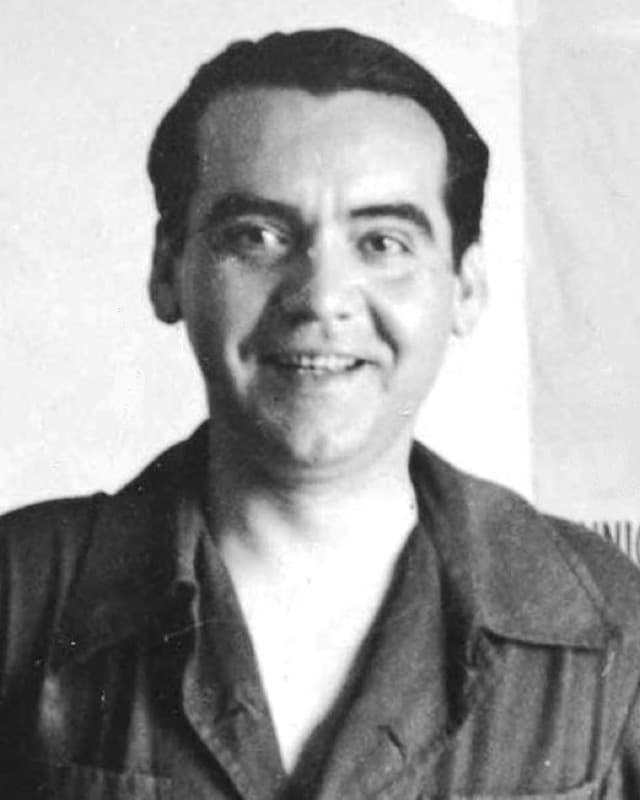
Born on June 5, 1898, in Fuente Vaqueros, a small town in the fertile plain west of Granada, Federico García Lorca was the eldest child of a wealthy landowner and a schoolteacher mother who gave him his first piano lessons. He grew up surrounded by the folk songs, flamenco rhythms, and puppet theaters of rural Andalusia, and these forms would saturate his mature work. He enrolled at the University of Granada but was a restless student; it took him nine years to earn a degree, during which time he published his first book of prose and moved to the Residencia de Estudiantes in Madrid, where his fellow residents included the filmmaker Luis Buñuel and the painter Salvador Dalí. Libro de poemas (1921) was followed by the Romancero gitano (Gypsy Ballads, 1928), a collection that fused Andalusian folk imagery with surrealist technique and made him the most famous poet in Spain almost overnight. After a personal crisis and a painful break with Dalí, he traveled to New York in 1929, producing Poeta en Nueva York (published posthumously in 1940), a sequence of anguished surrealist poems about race, capitalism, and alienation. Returning to Spain, he turned to the theater with a trilogy of rural tragedies, Bodas de sangre (Blood Wedding, 1933), Yerma (1934), and La casa de Bernarda Alba (The House of Bernarda Alba, completed 1936), that rank among the masterpieces of twentieth-century drama. He directed La Barraca, a traveling theater company that brought classical Spanish plays to rural villages. When the Spanish Civil War erupted in July 1936, Lorca, who had never joined any political party but was openly left-leaning and homosexual, returned to Granada, where Nationalist forces arrested him. He was shot by a firing squad on August 18 or 19, 1936, near the village of Víznar. He was thirty-eight. His body has never been found.
In 1932, Lorca founded La Barraca, a state-funded student theater troupe. Wearing blue overalls, he loaded scenery onto a truck and drove into remote Spanish villages, staging free performances of Golden Age classics by Calderón and Cervantes for peasants who had never once seen a play performed live.
The first button needs the app on this device; the second gets it there.
In the canon
- Canción del Jinete1927
- Romance Sonámbulo1928
- Romance de la Luna, Luna1928
- La Casada Infiel (The Faithless Wife)1928
- La Aurora1929
- Ode to Walt Whitman1930
- Blood Wedding1932
- Yerma1934
- Lament for Ignacio Sánchez Mejías1935
- The House of Bernarda Alba1945