
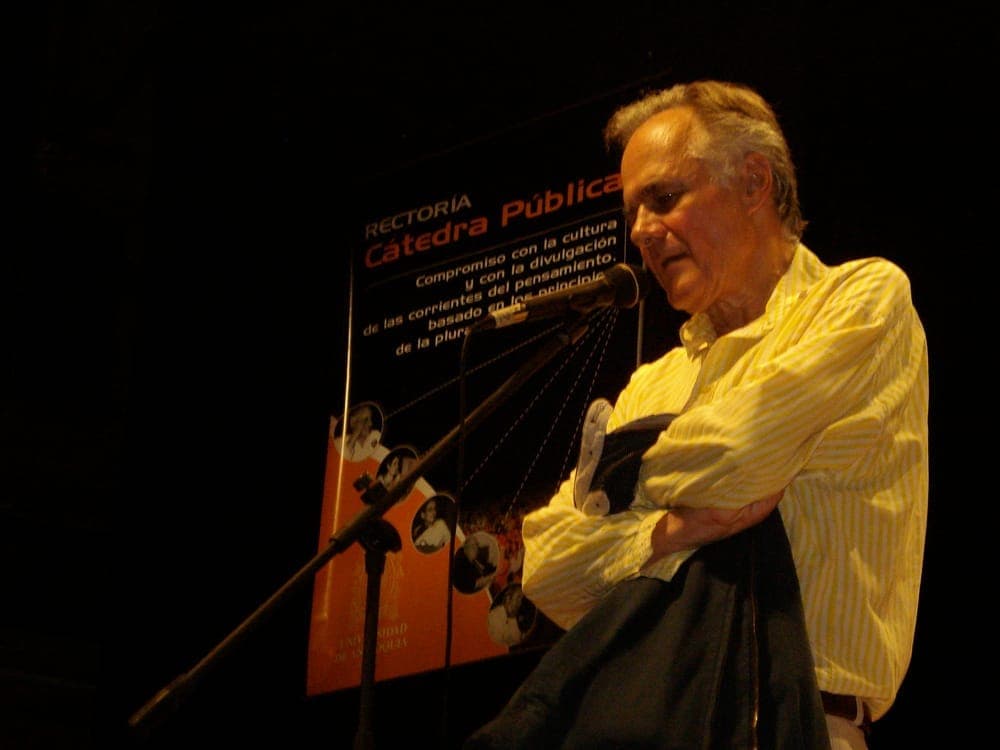
Author
Fernando Vallejo
- Lived
- Lived born 1942
- From
- From Colombian-Mexican
- Born in
- Born in Medellín, Colombia
Born Fernando Vallejo Rendón on October 24, 1942, in Medellín, Colombia, into a large, devoutly Catholic family whose piety he rejected almost as soon as he could read, he studied philosophy for a single year at the Universidad Nacional in Bogotá before abandoning it for biology, which he completed at the Universidad Javeriana, and then spent a year at Rome's Centro Sperimentale di Cinematografia learning film. He returned to Colombia to direct his first feature, but censorship troubles drove him out of the country in 1971, and he settled in Mexico City, where he met the set designer David Antón at a party and moved into the Condesa apartment they would share for the rest of Antón's life. From 1983 he wrote Logoi, a treatise on literary grammar, then the five autobiographical novels of El río del tiempo, before La virgen de los sicarios, Our Lady of the Assassins (1994), a scalding, fictionalized return to a Medellín ruled by drug money and teenage hitmen, made him internationally known and was filmed by Barbet Schroeder in 2000. El desbarrancadero, The Abyss (2001), followed his brother Darío's death from AIDS in the family's Medellín house and won Vallejo the Rómulo Gallegos Prize in 2003, the whole of which he gave away to a Caracas dog shelter. In 2007 he became a Mexican citizen and publicly renounced his Colombian nationality in protest at the country's politics, and in 2011 he won the FIL Award for literature in Romance languages. An atheist, a vegan, and a committed animal-rights advocate who has spent much of his income on stray dogs in four cities, he lived through Mexico City's September 2017 earthquake, which left cracks in his apartment's walls, and that December lost Antón, his partner of forty-seven years, at ninety-four. Vallejo returned for good the following year to the Medellín he was born in and had spent decades calling a swamp, settling there with his dog Brusca and continuing to write.
In 2003 Vallejo won the Rómulo Gallegos Prize, the grandest honor in Spanish-language fiction, worth one hundred thousand dollars. He kept none of it, giving the entire sum to Fiorella Dubbini, an Italian woman in Caracas who had spent years sheltering the city's stray dogs on a plot of land she called Mil Patitas.
The first button needs the app on this device; the second gets it there.
In the canon
- Our Lady of the Assassins1994
- The Abyss2001