
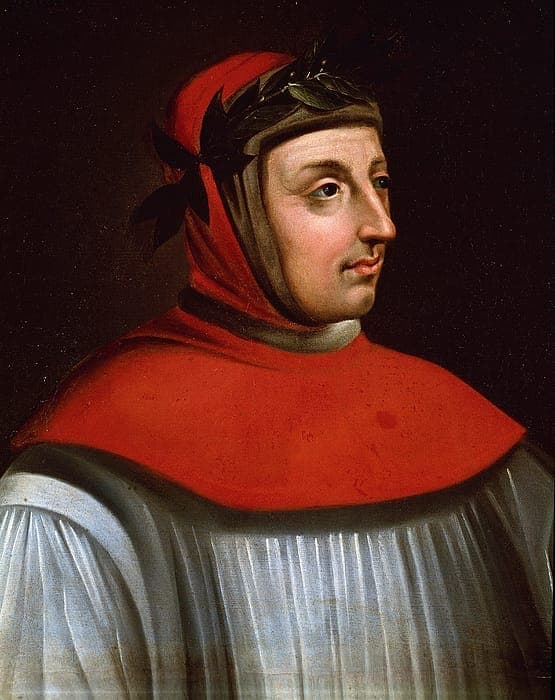
Author
Francesco Petrarca
- Lived
- Lived 1304 to 1374
- From
- From Italian
- Born in
- Born in Arezzo, Tuscany
Born Francesco di Petracco on July 20, 1304, in Arezzo, Tuscany, the son of a notary who had been exiled from Florence with Dante Alighieri, the boy who would Latinize his name to Franciscus Petrarcha spent his early childhood in the village of Incisa and then moved with his family to Avignon to follow the papal court of Clement V. Set to study law at Montpellier and Bologna, he considered the seven years wasted and quarrelled with his father, who once threw his Cicero and Virgil into a fire. After his parents died in 1326 he took minor clerical orders in Avignon, work that left him time to write. On Good Friday 1327, in the church of Sainte-Claire, he saw a woman he calls only Laura; she became the subject of the 366 Italian lyrics that make up his Canzoniere, the most influential body of lyric poetry in European literature. His Latin epic Africa, on Scipio Africanus, made him a celebrity; on April 8, 1341, he was crowned poet laureate on the Capitoline Hill in Rome, the first since classical antiquity. He travelled constantly, served as ambassador and clerical diplomat, climbed Mont Ventoux in 1336 for the sheer pleasure of the view, and in 1345 discovered in the chapter library of Verona a lost collection of Cicero's letters that altered the course of Renaissance humanism. He fathered two children by an unknown woman and later legitimized both. He died on the night of July 18 or 19, 1374, in Arquà in the Euganean Hills, the day before his seventieth birthday, found at his desk with his head resting on a manuscript of Virgil.
In 1336 Petrarch climbed Mont Ventoux in Provence for no reason but the view, an ascent historians call one of the first made purely for pleasure. At the summit he opened his copy of Augustine's Confessions at random. The passage that met his eyes rebuked men who marvel at mountains and rivers while neglecting their own souls.
The first button needs the app on this device; the second gets it there.
In the canon
- Voi ch'ascoltate in rime sparse il suono (Sonnet 3)1327
- Petrarch's Songbook1341