
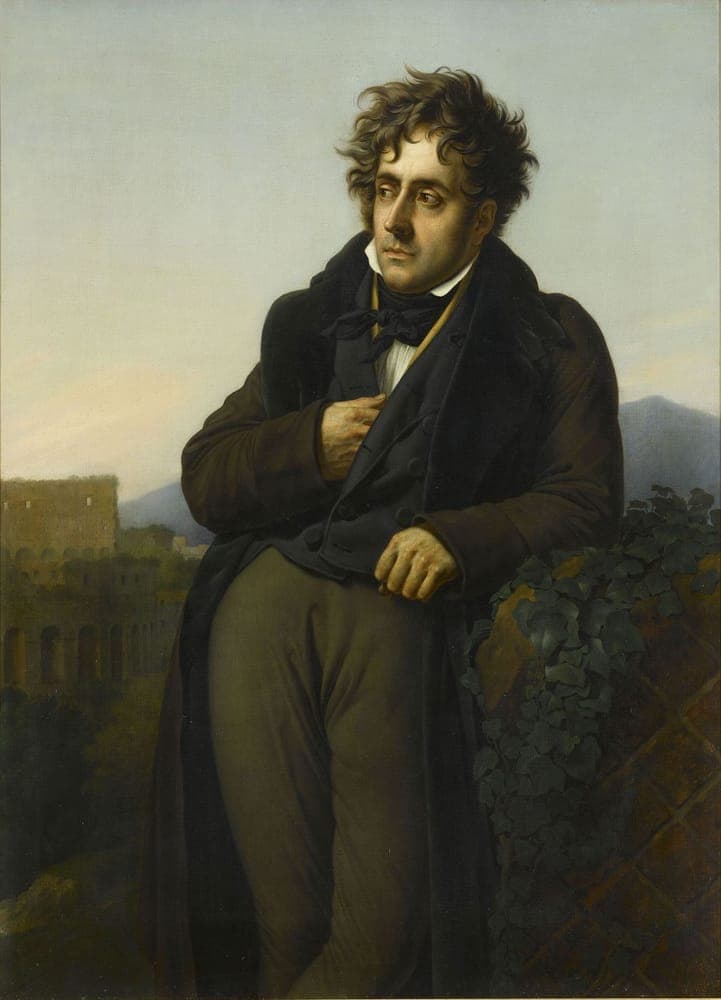
Author
François-Auguste-René de Chateaubriand
- Lived
- Lived 1768 to 1848
- From
- From French
Born François-René de Chateaubriand on September 4, 1768, in Saint-Malo on the Breton coast, the last of ten children of a morose ship captain who had grown rich on the slave trade, he was raised at the family castle of Combourg amid silence and long countryside walks with his sister Lucile. At seventeen he took a commission in the Navarre Regiment. The Revolution made him a sympathetic observer who quickly grew alarmed, and in 1791 he sailed for North America, where he spent five months travelling among the Native peoples of the Mohawk and Niagara country, breaking his arm at the falls. He returned to fight briefly with the émigré army, was wounded, and lived in destitute exile in London until 1800. His Génie du christianisme (1802), a defence of the Catholic faith that contained the novella René, helped reconcile post-revolutionary France with the Church and made him famous overnight. Atala (1801), the love story of a Christian Native woman in the Louisiana wilderness, had already sold out five editions in a year. He served as Napoleon's chargé d'affaires in Rome, resigned in protest at the execution of the Duc d'Enghien, and became under the restored Bourbons a minister, an ambassador to four capitals, and Foreign Minister from 1822 to 1824. He spent his last decades writing the Mémoires d'Outre-Tombe, the autobiography to be published only after his death, a book Proust read four times. He died in Paris on July 4, 1848, at seventy-nine, and was buried as he had asked, alone on the rocky islet of Grand Bé off Saint-Malo, facing the open sea.
The first button needs the app on this device; the second gets it there.
In the canon
- René1802
- Memoirs From Beyond the Grave1849