
Author
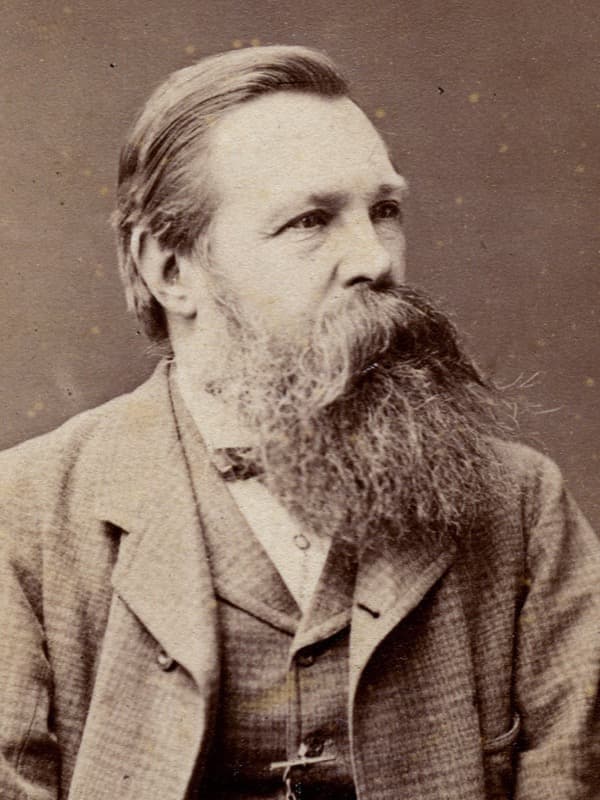
Friedrich Engels
- Lived
- Lived 1820 to 1895
- From
- From German
Born on November 28, 1820, in Barmen, a textile-manufacturing town in the Prussian Rhineland, Friedrich Engels was the eldest son of a wealthy cotton mill owner and a devoutly Pietist mother. He was pulled from school at seventeen to work in his father’s business and never attended university, a fact that makes his subsequent intellectual output all the more remarkable. Sent to Manchester in 1842 to manage the family’s stake in the cotton firm of Ermen & Engels, he walked through the slums of industrial England and produced The Condition of the Working Class in England (1845), a work of firsthand social investigation that remains a foundational text of urban sociology. In Paris in 1844 he met Karl Marx, and a ten-day conversation at the Café de la Régence launched the most consequential intellectual partnership of the nineteenth century. Together they wrote The German Ideology (1846), which laid out the materialist conception of history, and The Communist Manifesto (1848), whose opening line, “A spectre is haunting Europe”, became one of the most famous sentences ever written. For the next two decades, Engels led a double life in Manchester: a respectable cotton merchant by day, funding Marx’s research and the revolutionary movement by night, while maintaining a relationship with the Irish working-class sisters Mary and Lizzie Burns. After Marx’s death in 1883, Engels devoted himself to editing the second and third volumes of Das Kapital from Marx’s notoriously chaotic manuscripts, an act of intellectual labor and devotion that shaped how the twentieth century understood Marxism. He also wrote The Origin of the Family, Private Property and the State (1884) and served as advisor to socialist parties across Europe. He died of throat cancer in London on August 5, 1895. At his request, his ashes were scattered off Beachy Head, on the chalk cliffs of the Sussex coast.
The first button needs the app on this device; the second gets it there.
In the canon
- The Origin of the Family, Private Property and the State1884