
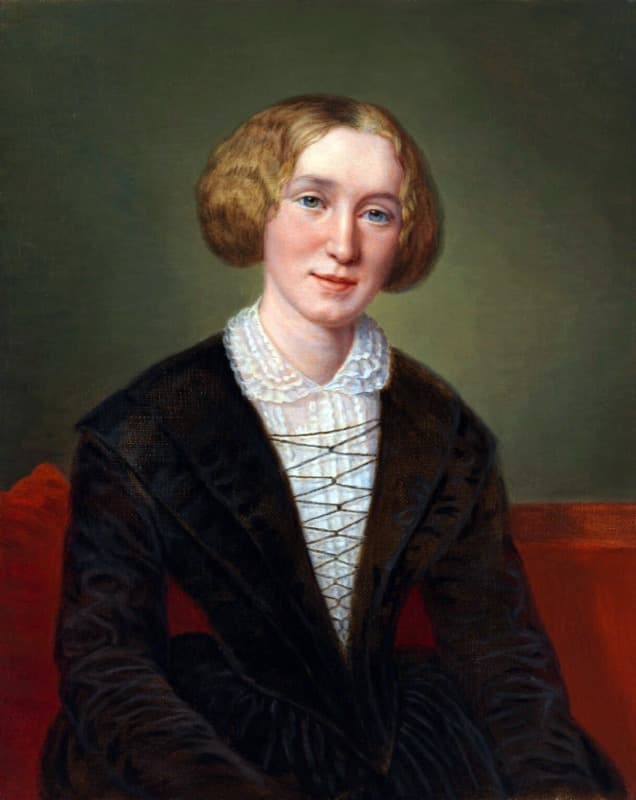
Author
George Eliot
- Lived
- Lived 1819 to 1880
- From
- From English
- Born in
- Born in Warwickshire, England
Born Mary Ann Evans on November 22, 1819, at South Farm on the Arbury Hall estate in Warwickshire, she was the daughter of Robert Evans, a land agent whose moral seriousness and deep knowledge of rural England would find its way into her fiction. Because she was considered plain and unlikely to marry well, her father invested in her education, an unusual decision for the era, and she was granted access to the great library at Arbury Hall, where she read voraciously. After her father's death in 1849, she moved to London and became assistant editor of the Westminster Review, entering the radical intellectual circles that included Herbert Spencer and the philosopher and critic George Henry Lewes. In 1854 she began living openly with Lewes, a married man unable to obtain a divorce, a scandal that made her a social outcast but also her most consequential life decision. It was Lewes who encouraged her to write fiction, and under the pen name George Eliot she published her first novel, Adam Bede (1859), to immediate acclaim. The Mill on the Floss (1860), Silas Marner (1861), and the political novel Felix Holt, the Radical (1866) followed. Then came Middlemarch (1871–1872), a panoramic study of provincial life that Virginia Woolf called "one of the few English novels written for grown-up people" and that Martin Amis and Julian Barnes have each named the greatest novel in the English language. Daniel Deronda (1876) was her last novel. Lewes died on November 30, 1878. In May 1880, eighteen months after his death, she married John Walter Cross, a man twenty years her junior. She died on December 22, 1880, at the age of sixty-one.
When Scenes of Clerical Life appeared in 1858 under the name George Eliot, most readers pictured a country clergyman. Charles Dickens, reading it, was almost alone in guessing the truth: only a woman, he wrote, could have made those womanly touches. His letter of admiration went to a stranger whose real name he did not know.
The first button needs the app on this device; the second gets it there.
In the canon
- Scenes of Clerical Life1858
- Adam Bede1859
- The Lifted Veil and Brother Jacob1859
- The Mill on the Floss1860
- Silas Marner1861
- Romola1863
- Felix Holt, the Radical1866
- Middlemarch1871
- Daniel Deronda1876