
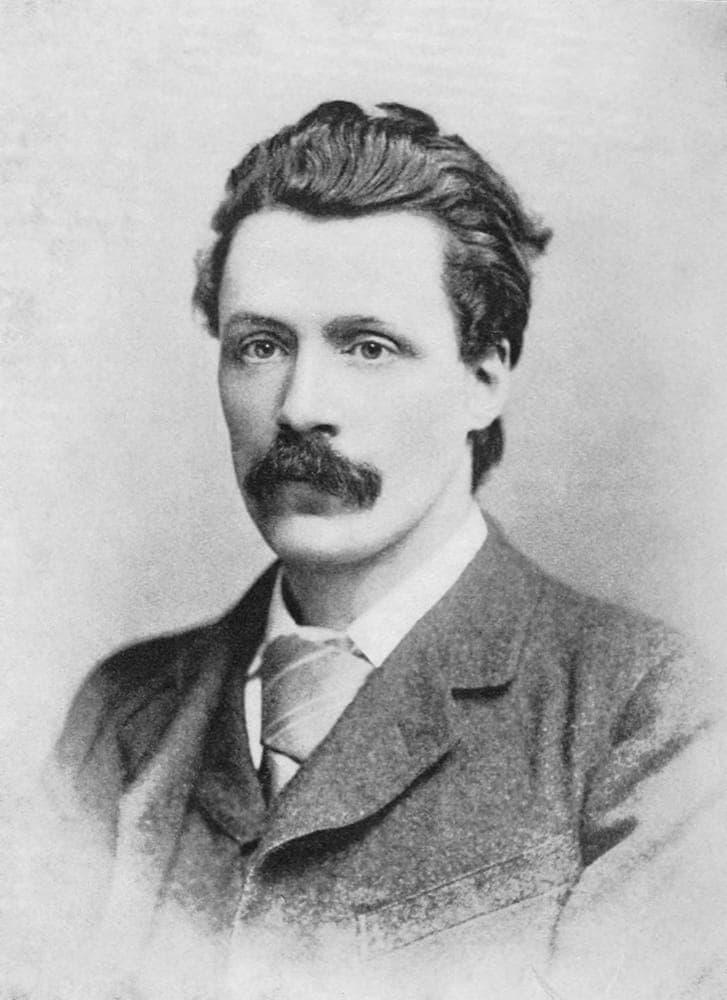
Author
George Gissing
- Lived
- Lived 1857 to 1903
- From
- From English
- Born in
- Born in Wakefield, England
Born on November 22, 1857, in Wakefield, Yorkshire, the son of a pharmaceutical chemist who kept a fine library and died when the boy was twelve, George Gissing was a prodigy who seemed bound for an academic career. At Owens College in Manchester he swept the prizes, then ruined himself for a young prostitute named Marianne Harrison, stealing from fellow students to support her. He was caught, expelled, jailed for a month, and shipped to America in disgrace. He sold short stories in Chicago, nearly starved, and came home to marry Harrison, whose alcoholism shadowed their squalid years until her death in 1888. Poverty became his subject. Workers in the Dawn (1880) and The Nether World (1889) mapped the London slums with a cold exactness, but his lasting book is New Grub Street (1891), the story of writers grinding their talent against the machinery of the literary marketplace, its idealist Edwin Reardon failing where the cynical Jasper Milvain thrives. The Odd Women (1893) turned to the lives of unmarried women and the new feminism. A second marriage, to Edith Underwood, proved as wretched as the first; she was eventually committed to an asylum. He found late contentment with Gabrielle Fleury, a Frenchwoman who translated his work, and in The Private Papers of Henry Ryecroft (1903) imagined the quiet retirement he never had. Always frail, worn by overwork and chronic lung disease, he died on December 28, 1903, at Ispoure in the French Pyrenees, of emphysema, aged forty-six. H. G. Wells, who hurried to his bedside, was among the last to see him.
On 7 May 1899, in Rouen, George Gissing and Gabrielle Fleury, a Frenchwoman he had met at H. G. Wells's house the summer before, held a private ceremony of marriage. It had no standing in law: his second wife, Edith, was alive in England, and he never divorced her. They lived as husband and wife in France until his death.
The first button needs the app on this device; the second gets it there.
In the canon
- New Grub Street1891
- The Odd Women1893
- The Private Papers Of Henry Ryecroft1903